Table of Contents
One Plan for Everything Rarely Works
Comparison of Business Continuity Plan and Disaster Recovery Plan
What a Business Continuity Plan Should Cover
What a Disaster Recovery Plan Should Cover
BCP and DRP Templates for Practical Implementation
Two Levels, One Common Process
What Decisions Does the BCP Make – and Which Not?
Information Reporting and Alerting Are Not the Same
Prepare Budget and Resource Decisions
After the Event
Measure RTA and Improve Plans
Brief Explanation
BCP and Recovery Plan in Five Points
- The Business Continuity Plan protects the organisation’s time-critical performance, while the Recovery Plan restores the resources needed for this.
- Both plans do not compete but are connected through clear references, shared time objectives, coordinated activation, and ongoing situational information.
- In the event of an incident, the BCP serves as the decision-making basis for priorities, dependencies, emergency operations, and time limits – however, it does not replace the authorised decision on escalation.
- Not only an actual RTO breach, but also its reliable forecast must trigger additional measures and, if necessary, escalation.
- A restored resource is not yet a restored process. The BCP checks the restart against three states – resource restored, process ready to start, performance restored – and the process’s RTA counts until the emergency operation level is reached.
One Plan for Everything Rarely Works
In many organisations, the terms Business Continuity Plan, Emergency Plan, Restart Plan, Recovery Plan, and Crisis Management Plan are used almost synonymously. This leads to documents that, although extensive, do not provide a clear answer in the event of an incident: Who must decide now? Which process takes precedence? Which resource is restored first? And when must a local disruption escalate into a higher-level emergency or crisis management?
A robust Business Continuity Management separates the different planning and decision-making levels. The Business Continuity Plan describes how prioritised activities are maintained or resumed within the business-defined time. A Recovery Plan, on the other hand, describes how a specific failed resource is technically or organisationally restored. The term Disaster Recovery Plan (DRP) is often used for the restoration of IT services, applications, data, and infrastructure.
Both types of plans belong together. However, they fulfil different tasks.
Core Statement: The Business Continuity Plan manages business continuity. The Disaster Recovery Plan or another Recovery Plan manages the restoration of a resource needed for this.
Comparison of Business Continuity Plan and Disaster Recovery Plan
| Business Continuity Plan – BCP | Disaster Recovery Plan – DRP or Recovery Plan |
|---|---|
| Business and process-oriented | Resource, service, or system-oriented |
| Secures prioritised activities and services | Restores a failed resource |
| Describes emergency operations and minimum performance level | Describes restoration steps and technical tests |
| Includes activation, roles, communication, and escalation | Includes prerequisites, sequence, configurations, and dependencies |
| Uses alternative procedures, fallback solutions, and prioritisation | Uses backups, spare components, failover, or repair procedures |
| References multiple Recovery Plans | Can serve multiple Business Continuity Plans |
| Derived from the requirements of the Business Impact Analysis | Must meet the specified RTO and, if applicable, RPO requirements |
The BSI Standard 200-4 accordingly distinguishes between business continuity planning and restart and recovery planning. The standard describes the restart as the transition to a pre-regulated emergency operation, business continuity as the execution of business processes in emergency operation, and recovery as the return of failed resources to a state that enables normal operation again. Restart, emergency operation, and recovery can run in parallel and must be coordinated. BSI Standard 200-4
The Course of an Event
Which Plan Works in Which Phase
What BCM achieves in the event of an incident is shown by the performance over time. With the damage event, business operations collapse. How deep and how long depends on whether the organisation is prepared and which plans take effect in which phase.
Overview of the Phases
- Damage Event and Reaction Time: Time passes for detection, reporting, assessment, and declaration of emergency before measures take effect. Not every disruption is an emergency: The BSI Standard 200-4 refers to an emergency when at least one time-critical business process cannot be restored to normal operation within the maximum tolerable downtime. Disruptions are handled by incident management; its processes must seamlessly transition into alerting and escalation. How disruption, emergency, and crisis are delineated and which triggers escalate is shown in the article Business Continuity Management. The process is described in the section From Incident to Escalation.
- Restart: Failed resources are brought back into operation at a coordinated emergency operation level. The emergency operation level specifies for each business process how capable the emergency operation must be. Whether this succeeds in time is shown by comparing the actual restart time (RTA) with the required restart time (RTO).
- Emergency Operation: Time-critical business processes continue to run to the required extent until the failed resources are restored.
- Recovery: Resources are procured, replaced, or re-established until normal operation is possible again, ideally in an improved state.
- Data Status: The actually achievable data status (RPA) must meet the RPO requirement, i.e., limit the data loss that is still tolerable.
- Time Limit: The entire interruption must remain within the maximum tolerable downtime (MTA). After that, intolerable impacts occur.
Terms and definitions according to the BSI Standard 200-4, Chap. 2.1, 7, 8, 11, and 12. The time terms are explained in detail in the article RTO, RPO, RTA, and SLA.
What Benefit Each Plan Brings
| Plan | Level | Phase | Benefit |
|---|---|---|---|
| Incident Management, Incident Response Plan | Disruption, often IT | Detection to Escalation | Quickly resolve disruptions and timely recognise when an emergency is imminent |
| Business Continuity Plan, Business Continuity Plan (BCP) | Business Process | Emergency Operation | Maintain time-critical services at a minimum level, set priorities and time limits |
| Restart Plan (RAP), part of a Disaster Recovery Plan | Resource | Restart | Bring resources to emergency operation level within the RTO |
| Recovery Plan (RHP) | Resource | Recovery | Enable normal operation again, possibly improved |
The assignment of BCP and DRP to the plans of the BSI Standard is our classification. The standard itself uses the terms business continuity, restart, and recovery plan.
With and Without BCM
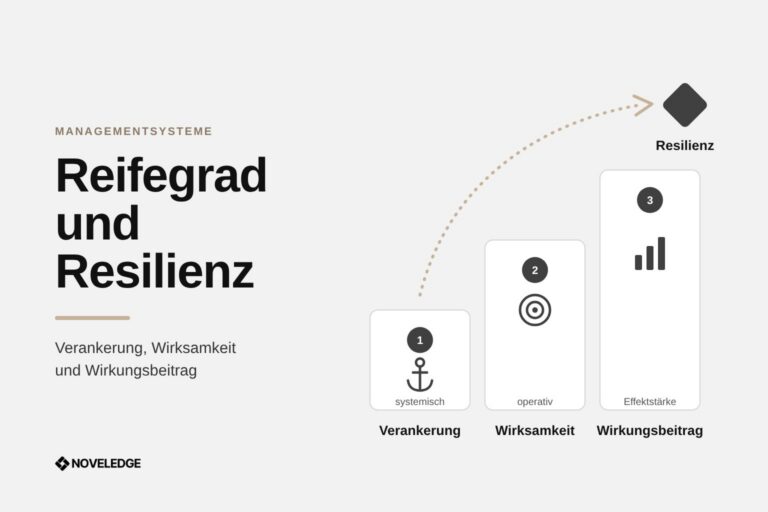
The benefit of the plans is that the organisation does not have to improvise. Without preparation, it takes longer for decisions to be made, the emergency operation is not defined, and the restart follows no coordinated sequence. With BCM, priorities, emergency operation levels, and time specifications are derived in advance from the Business Impact Analysis, and the plans state who does what in which order. Whether this holds in an emergency is only shown by comparing RTA and RTO in exercises and incidents. Why this is a separate maturity level is described in the article Maturity of Management Systems.
What a Business Continuity Plan Should Cover
A BCP is not a technical repair manual. It is a structured guide for action and decision-making for the continuation and restart of time-critical business processes. Its specific scope must fit the organisation, the process, and the intended emergency operation level.
Central contents include:
1. Scope and Plan Object
- Affected business process or service area,
- Process responsibility and BCP owner,
- Organisational and spatial scope,
- Interfaces to upstream and downstream processes,
- Referenced recovery, communication, and crisis management plans.
2. Activation and Termination
- Observable activation criteria,
- Decision-making authority for activation,
- Possibility of precautionary or partial activation,
- Alerting and information channels,
- Criteria for de-escalation and return to normal operation.
3. Business Requirements
- Maximum Tolerable Period of Disruption or maximum tolerable downtime,
- Recovery Time Objective as the required restart time,
- Minimum Business Continuity Objective or emergency operation level,
- Legal, contractual, and regulatory deadlines,
- Priorities within the process.
4. Measures for Business Continuity
- Manual alternative procedures,
- Alternative work locations or production possibilities,
- Fallback systems and alternative communication channels,
- Reduced service scopes,
- Prioritisation of orders, customers, or services,
- Permissible deferrals of non-time-critical activities.
5. Required Resources and Dependencies
- Roles and required qualifications,
- Business applications and IT services,
- OT, machines, and production resources,
- Buildings, spaces, and media supply,
- Suppliers and external services,
- Information, documents, and communication tools.
This information does not need to be collected anew: It originates from the Business Impact Analysis and can be attached to the plan as a process profile.
6. Leadership, Communication, and Documentation
- Local emergency and management teams,
- Reporting points and escalation paths,
- Reporting intervals and situational information,
- Responsibility for decisions and measures,
- Approval, version, change history, and next review.
7. Restart and Release
- Restart conditions for each process with criteria and binding nature,
- reviewing and approving role, rule for differing results,
- permissible operating modes and the requirements applicable to each mode,
- return to normal operations with data reconciliation and completion of alternative procedures.
Details are described in the section Restart in the BCP.
ISO 22301 presents Business Continuity as a documented management system that must be planned, operated, monitored, reviewed, and continuously improved. ISO 22313 provides application guidance and emphasises that organisations should be able to continue products and services during a disruption at a pre-accepted capacity. ISO 22301:2019, ISO 22313:2020
What a Disaster Recovery Plan Should Cover
A Disaster Recovery Plan specifies the restoration of IT services, applications, data, or infrastructure. Outside of IT, more generally, recovery or restart plans are spoken of, for example, for machines, building supply, or external services. The following structure can be applied to all these plan objects.
Typical contents are:
- Clear plan object and responsible entity,
- Activation prerequisites and required accesses,
- Technical and organisational dependencies,
- Restoration sequence,
- Step-by-step instructions,
- Backup, failover, replacement, or procurement procedures,
- Required personnel, service providers, tools, and spare parts,
- Security and approval steps,
- Functionality and integrity testing,
- Technical acceptance and handover,
- Fallback options if recovery fails,
- Documentation of the actually achieved restart time.
A DRP or Recovery Plan thus answers the How of Recovery. The business priority and the required timing are specified by BIA and BCP.
BCP and DRP Templates for Practical Implementation
The professional separation must be reflected in the documents. The BCP template is structured per location: Part A governs the L1 processes with priorities, activation, escalation, and communication, while Part B contains a business continuity plan for each time-critical L3 process, including emergency operation level, alternative procedures, required resources, and restart matrix. The DRP template starts with the IT service or resource pool to be restored and guides through prerequisites, sequence, security approvals, recovery steps, tests, and professional handover.
Process Profile from the BIA
Part B for each time-critical process requires – responsibility, MTPD and RTO, preceding and subsequent processes, resources with dependencies, RTA and redundancy, as well as the information objects with their protection requirements – is already available following the Business Impact Analysis. The BIA templates from NOVELEDGE consolidate this information for each time-critical process into a print-ready profile with a single selection, which is attached to the BCP as an annex. This ensures nothing is duplicated or retyped, and the plan remains aligned with the BIA.
The profile is included in the BIA Template 2.0 with CIA protection needs analysis and the BIA Template 3.0, which additionally includes the risk analysis of resources. An example with fictional data shows what a profile looks like:
How to Use the Templates
- Define process boundaries: Establish time-critical service, scope, and consequences of disruption from the BIA.
- Define minimum operation: Determine verifiable sub-goals and the necessary roles, information, and resources.
- Document continuity measures: Incorporate alternative procedures, fallback locations, reduced services, and activation prerequisites into the BCP.
- Derive recovery needs: Create a DRP for complex IT services or resource clusters with dependencies, recovery sequence, and target time.
- Link plans: The BCP references the required DRPs; the DRP specifies the supported processes and the prescribed RTO and, if applicable, RPO requirements.
- Establish restart: In the business continuity plan of each time-critical L3 process, define operating modes, restart matrix, and approval (Chapters 7.6 to 7.8 of the BCP template). The matrix is processed during the event or exercise in a separate log; a completed example is shown in Appendix C.
- Test and exercise: Test contacts, approvals, alternative routes, recovery steps, and professional handover under realistic conditions. Results belong in a separate test or exercise log and subsequently in plan improvement.
The templates are starting points and must be adapted to the organisation, technologies, security requirements, and decision-making authorities. A completed template does not replace professional review or applicable operational and safety instructions. The same modular structure is also planned for the provision of editable BCP and DRP modules in the NOVELEDGE app.
Two Levels, One Common Process
A modular plan landscape can be divided into three levels:
- Top Layer – Overarching Processes: Framework, priorities, and overarching business continuity.
- Middle Layer – Operational Processes and Activities: Specific emergency operation measures of the departments.
- Bottom Layer – Resources: IT, OT, buildings, personnel roles, service providers, and other resources with their own recovery plans.
The modules should be connected through clear references. A BCP does not need to fully repeat a technical recovery instruction. However, it must indicate which recovery plans are required, who activates them, what the target time is, and what alternative is available as long as the resource is not restored.
Across all levels, common requirements for responsibility, approval, alerting, accessibility, versioning, and change history apply. The BSI requires that BCMS documents are current, understandable, and accessible to the respective target group and that superior and subordinate documents do not contradict each other. BSI Standard 200-4, Documentation
Restart in the BCP
Assess Resource, Process, and Service Separately
When a failed resource is restored, the process is not necessarily restarted. An ERP system may be accessible while data is inconsistent, interfaces are disrupted, or permissions are not restored. And a restarted process does not automatically deliver its services to the intended extent. Therefore, the BCP should assess the restart based on three states:
- Resource Recovered: Every required resource is available in the necessary scope and has been functionally tested. Recovery, testing, and handover are governed by the Recovery Plan, which reports this status.
- Process Ready: The technical, organisational, and, if applicable, regulatory prerequisites are met, and the restart is authorised.
- Service Restored: The process is delivering its products or services again at the defined emergency operation level – verifiable and sufficiently stable.
The three states are checkpoints, not strictly sequential phases. Technical assessments can begin while individual resources are still being recovered. In the modular plan landscape, the Recovery Plan reports „Resource Recovered“ for each resource, the Business Continuity Plan confirms „Process Ready,“ and the overarching BCP confirms that the service is restored.
Dependency is Not the Same as a Restart Condition
A dependency describes that a process requires something external. A restart condition describes what specifically must be fulfilled before it can restart. For the restart, four types of dependencies must be distinguished:
- Resource: Production requires a specific facility.
- Process: Shipping requires picking.
- Information: Invoicing requires verified order data.
- Approval: Delivery requires product approval.
What is crucial is where a condition applies. Production can restart before quality control is completed—delivery is only allowed after approval. Therefore, the condition belongs to delivery, not production. Additionally, a testing process itself can be time-critical, with its own resources such as a laboratory application, qualified personnel, or an external testing body. It must also be restorable.
The Restart Matrix
In the BCP, only the checkpoints that are actually necessary for the restart are defined for each process. Each checkpoint specifies the criterion, binding nature, as well as the assessing and approving role. Three levels of binding nature have proven effective:
- Blocking: Without fulfilment, the process or process step cannot be resumed.
- Conditional: A deviation is permissible within defined limits with an approved alternative measure or temporary restriction.
- Informative: The checkpoint serves the situational overview but does not prevent the restart.
Ten assessment areas serve as orientation: resource availability, technical functionality, upstream processes, data and information, personnel and organisation, safety and quality, legal and regulatory requirements, approvals, performance capability, as well as stability and handover. Depending on the scenario, specific checkpoints are added—different after a power outage than after a cyberattack with potentially manipulated data.
A fictional example illustrates why the separation is important:
| Checkpoint | Criterion | Role | Status |
|---|---|---|---|
| IT Recovery | ERP System functional | IT Operations | fulfilled |
| Data Verification | Order data consistent | Application Responsibility | fulfilled |
| Interfaces | Warehouse and shipping system connected | IT Operations | fulfilled |
| Upstream Process | Warehouse process operational | Logistics Management | fulfilled |
| Technical Review | Open orders reconciled | Process Responsibility | open |
| Approval | Minimum operation approved | Process Responsibility | open |
| Performance Test | Test order processed successfully | Operations | open |
| Confirmation | Emergency operation level reached | Performance Responsibility | open |
The resources have been restored, but the process is not yet ready to be initiated. The BCP outlines what needs to be checked. This is documented in a separate event or exercise log – ensuring the plan remains unchanged and the execution is traceable. The BCP template includes the restart matrix in every business continuity plan and an example filled out in Appendix C.
Approval and Operating Mode
A fully checked list is not yet an approval, and a technical recovery message does not replace the technical decision. The BCP therefore specifies who grants approval on what basis and who decides if IT reports a system as restored, but the department rejects the restart due to inconsistent data. Assessment and approval can lie with different roles. Verbal approvals in the situation are immediately documented and subsequently confirmed.
Approval is granted for a specific operating mode. Different criteria apply for emergency operation than for normal operation, such as a minimum staffing instead of regular staffing or a permissible alternative procedure instead of the productive system. Mandatory safety, quality, and compliance requirements apply in every mode.
What This Means for the RTA
The RTA of the process does not end with the restoration of the resource, but when the emergency operation level is reached. A fictional example, calculated from the start of the interruption at 08:00: The resources are restored by 12:00, the process is ready to start by 18:00, the emergency operation level is reached by 04:00 the following day. The RTA is 20 hours. With an RTO of 16 hours, the target is missed—even though the resources were available after just four hours.
Review and approval times should therefore be included in the time budget (see „Check Time Criticality and Time Budget“) and in the exercises: A successful DRP test does not yet prove that the process will resume its performance in a timely manner.
What Decisions Does the BCP Make – and Which Not?
A BCP can prepare, structure, and enable decisions within pre-transferred authorities. However, it does not automatically replace the responsible leadership or crisis organisation.
The BCP can, in particular:
- Make affected processes and resources visible,
- Provide time objectives and priorities,
- Trigger prepared emergency operation measures,
- Present available action options and their consequences,
- Name roles, contacts, and reporting paths,
- Structurally capture the status of measures,
- Indicate impending target violations.
A responsible decision-making body must, on the other hand, decide, for example:
- Whether the event is classified as a disruption, emergency, or crisis,
- Whether and to what extent the BCP is activated,
- Which processes take precedence in resource conflicts,
- Whether prepared measures are deviated from,
- Whether additional financial or personnel resources are released,
- Whether a local team, the overarching BCM function, or a crisis team is activated,
- Whether external parties, authorities, customers, or partners are informed.
Emergency and crisis decisions therefore require clearly defined authorities. A plan must not give the impression that a checklist could fully automate complex leadership decisions. ISO 22320 classifies incident management as an interplay of roles, responsibilities, tasks, information management, resource control, and joint leadership. ISO 22320:2018
From Incident to Escalation
The second representation connects incident management, BCP, recovery, and crisis management. Professionally, the process should be explained in seven steps.
1. Detect and Report Incident
An event can be detected by employees, technical monitoring, service providers, authorities, or other external parties. The report should include at least the time, location, affected areas, current impacts, possible cause, and already initiated immediate measures. The BSI distinguishes between information, which initially creates transparency, and an alert, which triggers action by the responsible management organisation. BSI Standard 200-4, Detection, Alerting, and Escalation
2. Identify Impacts – Do Not Wait for Complete Cause Clarification
The cause is important for technical resolution. However, it does not need to be fully known before continuity measures begin. For BCM, the key questions are:
- Which service is impaired?
- Which time-critical processes are affected?
- Which resources are unavailable?
- How does the impact develop over time?
- Which legal or contractual deadlines are running?
The continuity decision thus follows the all-hazards approach: The organisation responds to the business impacts, even if the specific cause is still being investigated.
3. Check Time Criticality and Time Budget
The central time question is not just how long the outage has already lasted. What matters is how much usable time remains:
Remaining Control Time = Process RTO minus time already elapsed minus necessary technical commissioning and testing time.
Additionally, MTPD, emergency operation level, as well as legal and contractual deadlines must be considered. The RTO must not be exhausted to the last minute if a technical test or process execution is required afterward.
4. Prioritise and Commission Recovery
The responsible decision-making body prioritises based on BIA and BCP information. Standardised recovery measures, manual alternative procedures, and business continuity measures are not necessarily alternatives. They can run in parallel:
- The Recovery Plan restores the failed resource.
- The BCP maintains the prioritised business activity at a defined minimum level until then.
5. Monitor Progress and Target Achievement
During management, at least the following information should be regularly updated:
- Current and forecasted recovery time,
- Remaining time until process and resource RTO,
- Achieved or expected emergency operation level,
- Status of critical recovery steps,
- Open dependencies and resource bottlenecks,
- Impacts on other processes, locations, or customers,
- Security, reporting, and compliance deadlines,
- Reliability of the current forecast,
- Required decisions, approvals, and emergency budgets.
The Recovery Time Actual – RTA is not just a forecast figure. It refers to the actually achieved restart time and can only be finally determined when the BC solution is productively available. During the event, a continuously updated recovery forecast is used. After recovery, the measured RTA is compared to the RTO. The BSI explicitly provides for this target-actual comparison; an RTA above the RTO indicates an insufficiently secured time-critical resource. BSI Tools for BC Metrics
6. Escalate Early – Not Only After RTO Breach
A BCP should contain escalation indicators but assign the decision to the authorised entity. Typical criteria are:
- The RTO is unlikely to be met according to the current forecast.
- The defined emergency operation level cannot be established or maintained.
- The recovery duration is unknown or the forecast is unreliable.
- Multiple time-critical processes compete for the same resources.
- Dependent processes, locations, or service providers are also affected.
- Local action possibilities, authorities, or budgets are insufficient.
- Security, regulatory, or contractual deadlines are at risk.
- Impacts on people, environment, customers, reputation, or supply are increasing.
- Prepared recovery and alternative measures remain ineffective.
The escalation point is thus not only at the actual RTO breach. Escalation should occur as soon as reliable indications show that the target is unlikely to be achieved without additional decision or resources.
7. Activate Local or Higher-Level Management
Depending on the scope, the response can be staged:
- Activate Local Team: if the outage can be managed with local measures and authorities.
- Inform Higher-Level BCM Function: for assessment, advice, coordination, and reporting.
- Activate Emergency or Crisis Team: if multiple areas are affected, strategic decisions are required, or local resources are insufficient.
The specific naming and distribution of competencies must be determined individually by the organisation. The BCP provides the process-related facts. The higher-level leadership organisation consolidates the situation, prioritises organisation-wide, and decides on additional resources or deviations.
RTO, MTA, and Triggers
The escalation levels follow a time logic from the Business Impact Analysis. Two metrics set the boundaries:
- MTA: The maximum tolerable downtime counts from the start of the interruption and marks when the impacts are no longer bearable.
- RTO: The required restart time counts from the declaration of emergency until the commissioning of the emergency solution. It must be shorter than the MTA, preferably with a buffer, because detection and reporting already take time.
This results in three handlings:
- According to Plan: The restart runs via BCP, DRP, or alternative procedures. The goal is an RTA that meets the RTO.
- Trigger 1, RTO Likely to Be Exceeded: The situation is escalated to the next level according to the BCP (Step 6). Plans are adjusted, resources are added, and priorities are reset. As long as the MTA is maintained, it remains an emergency.
- Trigger 2, Crisis: The MTA is unlikely to be maintained, suitable plans are missing, or the impacts extend beyond the organisation itself, for example, to customers, authorities, or the public. Then the crisis team takes over and decides situationally (Step 7).
The MTA threshold is not a feature of the crisis in the sense of the BSI Standard but a practical signal that the existing plans are no longer sufficient. Where exactly it lies is determined by each organisation in its BCP. Basis: BSI Standard 200-4, Chap. 2.1 and 7, as well as DIN EN ISO 22301:2020-06, Sect. 8.2.2. How disruption, emergency, and crisis are conceptually delineated is shown in the article Business Continuity Management.
Information Reporting and Alerting Are Not the Same
Not every disruption immediately requires a crisis team. Nevertheless, early information can be useful. This allows the responsible decision-making body to prepare and act more quickly in case of escalation.
A practical gradation is:
- Observe: Disruption resolution is ongoing, RTO and minimum performance are not at risk according to the current forecast.
- Inform: A risk is possible; no additional leadership decision is required yet.
- Alert: An action or decision by the special organisation is required.
- Escalate: Scope, dynamics, or resource conflicts exceed local management capability.
The thresholds must be defined in advance, documented clearly and accessibly. At the same time, the principle should apply to inform early in case of doubt. The BSI recommends, in case of uncertainty, to report rather too much than too little and requires a defined and documented alerting and escalation process. BSI Standard 200-4
Prepare Budget and Resource Decisions
BCPs should not create blanket financial authorisations. However, they can prepare which expenses are likely to be necessary in the event of an incident and who may approve them up to what limit. Useful information includes:
- Prepared emergency budgets or cost centres,
- Amount limits of local decision-making authorities,
- Responsible approval bodies outside business hours,
- Expected costs of prepared alternatives,
- Business impacts if not implemented,
- Simplified procurement and commissioning paths for emergencies.
This allows a decision between additional precaution, accelerated recovery, and accepted restriction to be based on comprehensible information.
After the Event Measure RTA and Improve Plans
After recovery and de-escalation, the work does not end. In particular, the following must be documented:
- actual activation and response times,
- times at which resources were restored, the process was released, and the emergency operating level was achieved,
- measured RTA and, if applicable, actual data loss,
- achieved emergency operating level,
- deviations from the BCP and Recovery Plan,
- decisions made and their informational basis,
- resource and communication issues encountered,
- necessary corrective and improvement measures.
The results flow back into BIA, target-actual comparison, strategies, BCPs, recovery plans, exercises, and training. Only this learning loop turns existing documents into effective Business Continuity Management.
Conclusion
A Business Continuity Plan and a Recovery Plan are not competing documents. The BCP protects the organisation’s time-critical performance; the Recovery Plan restores the resources needed for this. Their connection is created through clear references, shared time objectives, coordinated activation, and ongoing situational information.
In the event of an incident, the BCP also serves as a decision-making basis. It shows priorities, dependencies, emergency operation measures, and time limits. However, it does not replace the authorised decision on emergency or crisis escalation. Therefore, proactive monitoring is particularly important: Not only the actual RTO breach but also its reliable forecast must trigger a review of additional measures and, if necessary, escalation.