Table of Contents
Brief Explanation
The 4D Model in Four Points
Four Dimensions
What is Delivered, Responsible, Done, and Used
Value-Oriented
Why the Model Focuses on Performance
ISO 22301
What the Standard Requires and How the Model Organises It
Two Levels
RTO for Performance, RTA for Resources
Restart
How Activities Become a Sequence
Building Blocks
Where It Impacts BIA, Risk Analysis, and Data Model
Conclusion
Value Creation as a Benchmark
Frequently Asked Questions
Standard, Terms, and Introduction
Sources
Standards and Guidelines
Brief Explanation
The 4D Model in Four Points
- The starting point is the products and services through which an organisation creates value – not individual processes.
- Through business processes and activities, the human, technical, infrastructural, and external resources on which this value creation depends are determined.
- Resilience is not created at the process level but at the level of activities and their dependencies; here, the restart is prioritised and managed.
- The model translates the requirements of ISO 22301 into four interconnected dimensions, thus forming the basis for Business Impact Analysis, Risk Analysis, and Business Continuity Plan.
Four Dimensions
What is Delivered, Responsible, Done, and Used
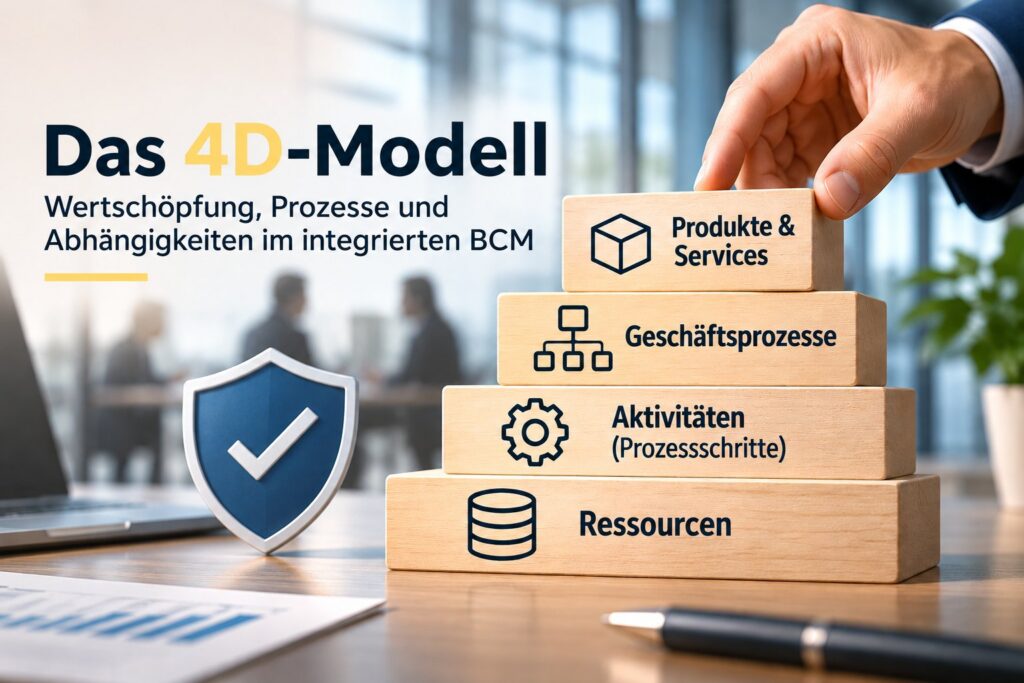
The 4D Model views an organisation across four levels that build on each other. Each level answers its own question – together, they form the picture needed for a Business Impact Analysis.
| Dimension | Guiding Question | Example |
|---|---|---|
| Products & Services | What is delivered? | Machine delivery to a customer |
| Business Processes with Responsibilities | Who does it? | Production, Logistics |
| Activities | What is specifically done? | Manufacturing, Shipping |
| Resources | With what is it done? | Personnel, IT, Facilities |
Products & Services are the business outputs through which an organisation creates value and generates revenue. They form the starting point: the aim is to protect not a process for its own sake, but the output that customers and the organisation require.
Business Processes organise operations into management, core, and support processes. Management processes control, core processes drive value creation and revenue, and support processes enable the core processes. At this level, responsibilities are also defined – who is responsible for a process and its recovery.
Activities are the individual process steps, typically at level 3 of a process map. They form the operational level, where recovery and restoration are prioritised and managed.
Resources encompass everything an activity requires to be carried out: human, technical, infrastructural, and external resources – such as personnel, IT systems, facilities and buildings, service providers, and suppliers.
Value-Oriented Instead of Process-Centred
Why the Model Focuses on Output
A process-centred approach evaluates each process individually. The result describes the structure of an organisation but does not reliably indicate which elements are truly critical for business operations.
The 4D Model reverses the perspective. It first asks which products and services are relevant for customers and the organisation, and then traces which processes, activities, and resources are needed for them. This shifts the focus from the isolated protection of individual processes to ensuring relevant value creation.
The classic division into core, support, and management processes remains useful – as a structural order. However, evaluation and management are conducted through activities, resources, and responsibilities. In short: resilience does not occur at the process level, but at the level of activities and their dependencies.
Relation to ISO 22301
What the Standard Requires and How the Model Organises
ISO 22301[1] does not prescribe a model with fixed dimensions. However, it requires in the Business Impact Analysis that an organisation determines the activities supporting its products and services, assesses the impact of an interruption over time, sets timeframes for resumption, and identifies the resources and dependencies of these activities – including suppliers and partners. Additional guidance is provided by ISO/TS 22317[2].
The 4D model translates these requirements into four clearly distinguishable yet interconnected dimensions: Products & Services define the business value, Processes structure the workflows, Activities describe the concrete implementation, Resources and Responsibilities enable them. This transforms the standard requirement into a structure that allows for the systematic assessment of time criticality and dependencies.
Controlling and Operational Level
RTO for the Output, RTA for the Resource
The model separates two levels. On the controlling level – products, processes, and activities – the business determines how long an interruption may last at most: the Recovery Time Objective (RTO). On the operational level – the resources – it becomes apparent how quickly a recovery can actually be achieved: the Recovery Time Actual (RTA).
For this to hold, the RTA of each required resource must be less than or equal to the RTO of the supported activity. Where this is not achieved, mitigation measures are applied at the resource level – such as backups, redundancies, or organisational measures. The terms and this basic rule are explained in the article RTO, RPO, RTA and SLA.
From Model to Restart
How activities become a sequence
In the Business Impact Analysis, activities are prioritised based on RTO and Maximum Tolerable Period of Disruption (MTPD) and recorded with their dependencies on resources. The Business Continuity Plan translates this prioritisation into a concrete restart sequence. The restart occurs in two stages:
- Restart (Emergency Operation): Initially, only the prioritised activities are resumed – with the minimally required resources, for example, at about 30 percent of normal capacity.
- Recovery (Normal Operation): Subsequently, all relevant activities are restored until full capacity is reached.
The level of emergency operation an activity requires is determined by assessing how heavily it depends on each of its resources. The article Business Continuity Plan and Disaster Recovery Plan illustrates how these plans interact.
The Model in Other Components
Where it impacts BIA, Risk Analysis, and Data Model
The 4D model is the common foundation of several specialist articles. Each addresses a different aspect:
- Business Continuity Management: indicates which steps of the analysis the model addresses – process dependencies and resources.
- Business Impact Analysis: assesses impacts, time constraints, and dependencies across the four levels.
- Risk Aggregation: derives the impact of a resource from the impacts of dependent processes – the path from bottom to top through the model.
- Integrated BCM/BIA Data Model: technically represents the relationships between products, processes, activities, and resources.
- Supply Chain Resilience: applies the logic to suppliers – their significance is determined by the supported service, the time criticality of a failure, and the available alternatives.
Conclusion
Value Creation as a Benchmark
The 4D model connects value creation, operational implementation, organisational responsibility, and resource dependencies. It highlights which elements are truly critical for business operations, thus providing a realistic and manageable basis for resilience assessment in BCM.
In practice, this means starting with products and services, moving through processes and activities to resources, and checking whether the actual recovery keeps pace with the business’s time requirements. This shifts BCM from a process-centred to a value-oriented approach.
Frequently Asked Questions
Standard, Terms and Introduction
Does ISO 22301 prescribe a 4D model?
No. The standard does not prescribe a dimensional structure. However, it requires the Business Impact Analysis to cover exactly the contents that the model organises: products and services, the supporting activities, as well as their resources and dependencies.
What distinguishes a process from an activity?
A process describes a coherent sequence, such as order processing. Activities are its individual steps, usually at level 3 of a process map. In the 4D model, prioritisation and recovery are managed at the activity level.
Why does the model start with products and services?
Because the purpose of BCM is not to protect individual processes, but to maintain the services that are relevant to customers and the organisation. Starting there helps identify which processes, activities, and resources are truly critical.
Sources
Standards and Guidelines
The information in this article is based on the following sources. Paid standards are not quoted verbatim; their contents are paraphrased.
- DIN EN ISO 22301:2020-06 – Security and Resilience – Business Continuity Management System – Requirements (ISO 22301:2019). German version EN ISO 22301:2019. Publisher: DIN Deutsches Institut für Normung e. V., Berlin. Available for purchase through standard trade. ↑
- ISO/TS 22317:2021 – Security and resilience – Business continuity management systems – Guidelines for business impact analysis. Publisher: International Organization for Standardization, Geneva. Available for purchase through standard trade. ↑