Table of Contents
Brief Explanation
Maturity and Resilience in Five Points
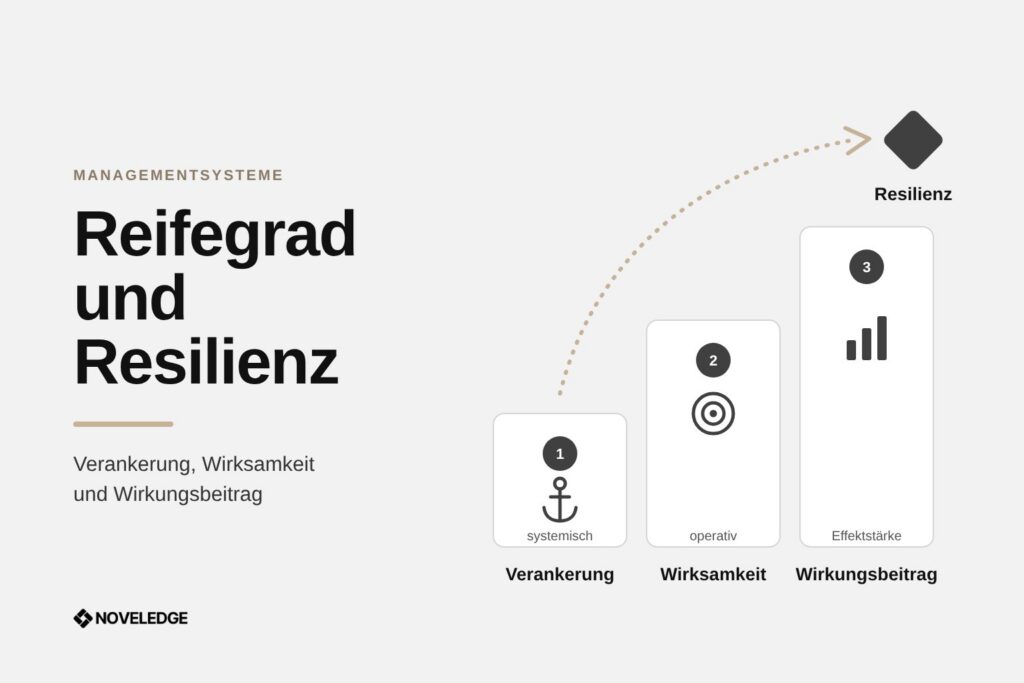
Three Levels
Why Maturity Alone is Not Enough
Development Stage
Scope and Methodology as a Starting Point
Anchoring
Systemic Maturity According to BSI RUN
Effectiveness
Operational Maturity as Measured Achievement of Objectives
Impact Contribution
How Strongly a Management System Enhances Resilience
Interaction
What is Proven and What Remains Open
Sources
Standards, Studies and Guidelines
Brief Explanation
Maturity and Resilience in Five Points
- A high maturity level on paper does not automatically make an organisation resilient. The statement only becomes robust when three levels are considered separately: Anchoring, Effectiveness, and Impact Contribution.
- The Anchoring (systemic maturity) can be assessed using the five stages of BSI RUN. The stage logic is generally held and fits the measurement framework of ISO/IEC 33020. Therefore, it can be transferred to other management systems, but not the specific audit aspects.
- The Effectiveness (operational maturity) is the measured achievement of objectives, in BCM, for example, the actual recovery time (RTA) compared to the target time (RTO).
- The Impact Contribution is not a stage of a single organisation, but an effect size determined across many organisations. A study with 140 tour operators shows: Practiced continuity practices strengthen planned, but also adaptive resilience.
- Whether a higher BCM maturity level leads to measurably better performance has not yet been empirically tested. This is where the impact model of the NOVELEDGE series comes in.
Three Levels
Why Maturity Alone is Not Enough
The Capability Maturity Model distinguishes three terms: Process Capability describes the results a process is expected to deliver, Process Performance the actual results achieved. Process Maturity indicates how far a process is explicitly defined, controlled, measured, monitored, and effective.[1]
ISO 22301 also asks not only whether a BCMS is implemented. The organisation must evaluate the performance and effectiveness of its BCMS.[2]
From this, we derive three levels for management systems. Preceding this is the development stage: which scope is covered with which methodology.
| Level | Guiding Question | Metric | Basis |
|---|---|---|---|
| Development Stage | What is considered and how deeply? | Scope and Methodology | BSI Standard 200-4 |
| Anchoring (Systemic Maturity Level) | How firmly is the system anchored and proven? | Level 1 to 5 | BSI RUN, ISO/IEC 33020 |
| Effectiveness (Operational Maturity Level) | Does the system achieve its goals, even in an emergency? | Proportion of target values achieved, e.g., RTA ≤ RTO | ISO 22301, BSI Standard 200-4 |
| Impact Contribution | How significantly does this performance enhance resilience? | Effect size per resilience dimension | Empirical studies |
In the Impact Model of the Series, anchoring and effectiveness belong to the „Maturity Level“ bridge. The impact contribution belongs to the „Context Model“ bridge, which asks which discipline affects which resilience dimension and to what extent.
Wirkungsmodell: Von Managementsystemen zum Nutzen der Organisation
Resilienzwirkung
1
Managementsysteme
BCM und weitere Disziplinen, die auf die Resilienz einwirken
2
Organisationale Resilienz
Fähigkeit, Störungen zu bewältigen und sich anzupassen:
- Antizipieren
- Absorbieren
- Wiederherstellen
- Anpassen
Wertbeitrag
3
Business Performance
Finanzielle und nicht finanzielle Leistung
4
Ökonomischer Nutzen
Je Organisation festgelegt: nach Form, Eigentümern und Auftrag
1 Managementsysteme im Modell
- Business Continuity Management
- Risikomanagement
- Informationssicherheit
- Cybersicherheit
- Physische Sicherheit
- Notfall- und Krisenmanagement
- Lieferkettenmanagement
- Compliance und Governance
- Nachhaltigkeit
- Qualität, Arbeits- und Umweltschutz (QHSE)
A Reifegrad
Wie gut ist ein Managementsystem aufgestellt? Systemisch in fünf Stufen (geplant, gesteuert, etabliert, messbar, kontinuierlich verbessert) und operativ an seiner Wirksamkeit gemessen.
B Zusammenhangsmodell
Welche Disziplin wirkt wie auf welche Resilienzdimension? Effekt-Matrix und die Frage, ob BCM einen Beitrag leistet oder die Beiträge orchestriert.
C Zielbild
Welche Performance zählt und welcher Nutzen steht im Fokus? Für jede Organisation eigens abzuleiten.
Dieser Beitrag: BCM in Station 1, resilience in Station 2, and Bridges A and B – how well a management system is anchored and effective, and how much it contributes to resilience.
NOVELEDGE-Wirkungsmodell der organisationalen Resilienz; erläutert im Beitrag Resilienz als Gesamtsystem.
Development Stage
Scope and Methodology as a Starting Point
The BSI Standard 200-4 describes three levels of a BCMS and simplifies them into two dimensions: Methodology and Business Process Scope. In a Reactive BCMS, analyses can be deferred; Development and Standard BCMS apply the full methodology. The scope expands with each cycle until all business processes within the scope are considered.[3]
| Level according to BSI | Methodology | Scope | Advantage | Disadvantage |
|---|---|---|---|---|
| Reactive BCMS | simplified | selected time-critical processes | quick emergency response capability | gaps in areas not or partially considered |
| Development BCMS | complete | limited scope | gradual, resource-efficient development | unconsidered areas |
| Standard BCMS | complete | all processes within scope | comprehensive protection, enhanced resilience | greater resource requirement per cycle |
A fully implemented Standard BCMS can, according to BSI, achieve the necessary maturity for certification under ISO 22301.[3] In our slides, Basic, Advanced, and Professional correspond to these three levels.
The development stage indicates what is considered, not how well. A small scope can be firmly anchored and effective, while a large one may only exist on paper. For critical infrastructures, RUN links both dimensions: From Level 2, the BCMS must consider the entire scope of the critical infrastructure.[4]
Anchoring
Systemic Maturity Level according to BSI RUN
With the maturity and implementation level assessment within the framework of the verification audit (RUN), the BSI evaluates the management systems of critical infrastructures in five levels: planned, controlled, established, measurable, and continuously improved. For each level, RUN considers process, documentation, and measures; this subdivision serves understanding according to BSI and is not a mandatory requirement.[4]
- Evidence of Time: From level 3, RUN requires evidence over an appropriate period, and from level 4, metrics and thresholds with which effectiveness is regularly measured and evaluated.[4]
- Audit Aspects in BCMS: Scope, business continuity, crisis management, data backups and recovery, secured emergency communication, handling of continuity risks, testing of emergency plans, audit and review, and continuous improvement.[4]
Also for Other Management Systems
Three findings suggest transferring the staged logic to other management systems:
- Generally Held: The BSI deliberately maintains the method for ISMS and BCMS at a general level of abstraction. The maturity levels for ISMS, BCMS, and attack detection systems are aligned with each other.[4]
- General Measurement Framework: ISO/IEC 33020 defines a measurement framework for process capability that should apply to all application areas and organisation sizes.[5] Based on this, Wolf developed a maturity model for the BSI Standard 200-4 and tested it in five organisations.[6]
- Same Basic Structure: ISO 22301 follows the common basic structure of the ISO management system standards with a uniform base text and common terms.[2] For quality management, ISO 9004 contains its own maturity model for self-assessment.[7]
| Level according to RUN | Level according to ISO/IEC 33020 |
|---|---|
| 1 planned | 0 Incomplete to 1 Performed |
| 2 controlled | 2 Managed |
| 3 established | 3 Established |
| 4 measurable | 4 Predictable |
| 5 continuously improved | 5 Innovating |
The Limit: The levels and the division into process, documentation, and measures are transferable. The audit aspects are subject-specific and must be redefined for each management system. Additionally, RUN is a summary assessment of the audit team; the BSI explicitly does not require determination according to more advanced scientific methods.[4] In testing a model based on ISO/IEC 33020, the response levels also proved to be not very distinct.[6]
Effectiveness
Operational maturity as measured goal achievement
A BCMS at level 4 measures its effectiveness with metrics and thresholds. RUN does not specify what level of goal achievement is sufficient.[4] This gap is filled by operational maturity. It describes the actual performance achieved, in terms of the Capability Maturity Model, the „actual results achieved“.[1]
In BCM, the measurement is close: The BSI Standard 200-4 compares the target time (RTO) with the actual recovery time (RTA) and the RPO with the actually achievable data state (RPA). The RTA is determined in exercises and tests; without tests, it is estimated by an expert.[3] Which metrics are suitable for this is shown in the article on BC strategies, how the values are generated, in the article on exercises and tests.
For all management systems, we propose the same logic: Each system sets impact goals with thresholds, and operational maturity is the proportion of measurements that meet the threshold. In BCM, this is, for example, the proportion of processes whose RTA in the exercise meets the RTO. For other management systems, the impact goals must be derived from the respective standard. Where the stage boundaries lie must be empirically calibrated.
Effectiveness and Resilience Dimensions
Effectiveness itself is not a dimension of resilience. It describes the performance of the management system, whereas resilience is an organisational capability. However, the metrics can be assigned to the four dimensions of the impact model. The assignment is our classification; the evaluation aspects are derived from RUN.[4]
| Dimension | Operational Metric in BCM (Example) | Evaluation Aspect according to RUN |
|---|---|---|
| Anticipate | Continuity risks assessed, measures implemented on time | Treatment of continuity risks |
| Absorb | Emergency operation maintains the defined minimum level during exercise or incident | Maintenance of operations |
| Restore | RTA ≤ RTO and RPA ≤ RPO | Data backup and recovery, testing of emergency plans |
| Adapt | Insights from exercises and incidents implemented | Continuous improvement |
Our assessment also shows where BCM metrics are sparse: Restoration is well measurable, while anticipation and adaptation are significantly more challenging.
In addition to achieving objectives, it is worthwhile to consider coverage and testing. These metrics indicate whether the prerequisites for effectiveness are in place:
- the proportion of time-critical processes with a current Business Continuity Plan and the proportion of those that have been rehearsed or tested in the past twelve months,
- the proportion of time-critical resources with a Disaster Recovery Plan and the proportion with successfully tested recovery,
- the proportion of key roles with designated and briefed deputies.
In our assessment, these are prerequisites, not outcomes: A tested plan does not yet demonstrate whether the recovery time meets the RTO. As metrics, they correspond to the recovery success rate and the evidence coverage from the article on BC strategies; how the measurements arise in exercises is shown in the article Exercises and Tests in BCM.
Impact Contribution
The extent to which a management system strengthens resilience
The impact contribution answers the question of how much an effective performance of the management system increases resilience. It cannot be determined from a single organisation. It is estimated across many organisations, for example, as a path coefficient (β) and effect size (f²) in a structural equation model.[8]
Two or Four Dimensions
ISO 22316 describes an organisation’s resilience as its ability to absorb and adapt to a changing environment.[9] There are two approaches for measurement:
- Two Dimensions: Lee, Vargo, and Seville distinguish between planning and adaptability. Planning includes, among other things, planning strategies, participation in exercises, and recovery priorities, while adaptability includes leadership, situational awareness, decision-making, and employee involvement.[10] Planned resilience occurs before an event, adaptive resilience manifests afterwards.[11] Empirical BCM studies have so far worked with this approach.
- Four Dimensions: Other works describe resilience along the course of disruption: prepare, absorb, restore, and adapt.[12] NIST describes cyber resilience as the ability to anticipate, withstand, recover from, and adapt to disruptions.[13] The impact model of the NOVELEDGE series uses these four dimensions.
Both approaches do not contradict each other. The two dimensions are categorised by the time a capability arises, while the four are based on the phase of disruption. According to our classification, planned resilience primarily covers anticipation and the prepared part of absorbing and restoring, while adaptive resilience involves adapting and improvisation when plans do not fit. Duchek supports the phase view with the successive stages of anticipation, coping, and adaptation.[14]
What Studies Show
Yulianto and colleagues surveyed 140 tour operators in Central Java and analysed the data using a structural equation model (PLS-SEM). Of the four BCM factors, only the embeddedness of continuity practices in everyday life significantly impacts resilience.[8]
| Path | β | f² | Result |
|---|---|---|---|
| Embeddedness of Continuity Practices → Planned Resilience | 0,611 | 0,305 | significant, classified by the authors as a large effect |
| Embeddedness of Continuity Practices → Adaptive Resilience | 0,535 | 0,210 | significant, medium effect |
| Management Support → Planned Resilience | 0,048 | < 0,02 | not significant |
| Organisational Preparation → Planned Resilience | 0,124 | < 0,02 | not significant |
| Organisational Preparation → Adaptive Resilience | 0,086 | < 0,02 | not significant |
| External Requirements → Adaptive Resilience | 0,191 | < 0,02 | not significant |
Both resilience dimensions in this study, in turn, impact financial performance (planned β = 0.555, adaptive β = 0.297).[8] A study of tourism businesses, however, found a significant effect on financial performance only for adaptive resilience, not for planned resilience.[11] Thus, the findings are not yet consistent.
Important for classification: The study measures lived BCM practices through surveys, not maturity levels, and it originates from a specific industry and region. Respondents also disagreed with statements that their emergency plans were tested for effectiveness; the authors see this as insufficient testing. This is precisely what operational maturity is meant to capture.[8] We did not find separate measurements of the four dimensions for BCM in the studies evaluated.
ISO 22316 recommends regularly assessing how each management discipline contributes to the organisation’s resilience.[9] The effect matrix in the article Resilience as a Complete System makes this question visible for all disciplines. If anchoring and effectiveness are measured in each management system according to the same logic, their fields can be comparably filled.
Interaction
What is proven and what remains open
Combined, this results in a chain: The level of development determines what is considered, anchoring makes the system permanent, effectiveness shows whether it delivers in an emergency, and the impact contribution indicates how much of it translates into resilience. From this, we derive three hypotheses:
- Anchoring → Effectiveness: A higher systemic maturity level leads to greater effectiveness. In software development, higher process maturity was associated with higher quality, shorter cycle time, and lower effort.[15] This has not been tested for BCM.
- Level of Development as Amplifier: The level of development determines how far the effectiveness extends into the resilience of the entire organisation. According to BSI, limited scope leaves gaps in the areas not considered.[3]
- Effectiveness → Performance: Greater effectiveness reduces performance loss after disruptions and thus improves business performance. This is supported by the relationship between BCM practices, resilience, and performance.[8]
Two main issues remain open. There is still largely a lack of a generally accepted, valid measurement scale for organisational resilience.[16] And none of the studies we evaluated examines whether a higher BCM maturity level is associated with measured better performance. Both are subjects of the author’s ongoing research into the impact chain of this series.
Where does your BCM stand?
The free BCM Maturity Check evaluates the level of development, anchoring according to BSI RUN, effectiveness, and impact contribution in about ten minutes. You will receive the evaluation with the next steps for each level as a PDF via email.
Sources
Standards, Studies, and Guidelines
The information in this article is based on the following sources. No direct quotations are taken from paid standards; their contents are paraphrased. Assignments and hypotheses marked as the author’s own interpretation are from NOVELEDGE.
- Paulk, M. C.; Curtis, B.; Chrissis, M. B.; Weber, C. V. (1993): Capability Maturity Model for Software, Version 1.1. Technical Report CMU/SEI-93-TR-24, Software Engineering Institute, Carnegie Mellon University, Pittsburgh, pp. 3–4. ↑
- DIN EN ISO 22301:2020-06 – Security and Resilience – Business Continuity Management System – Requirements (ISO 22301:2019). Sections 0.5 and 9.1. Publisher: DIN Deutsches Institut für Normung e. V., Berlin. Available for purchase through standards trade. ↑
- Federal Office for Information Security: BSI Standard 200-4 – Business Continuity Management. Version 1.0, 2023, Ch. 2.6 (Table 2) and Ch. 8. ↑
- Federal Office for Information Security: Maturity and Implementation Level Assessment within the Framework of Evidence Verification (RUN). Version 1.0, 02.01.2025, Ch. 1 to 3. ↑
- ISO/IEC 33020:2019 – Information technology – Process assessment – Process measurement framework for assessment of process capability. Sections 1 and 5.3. Publisher: ISO/IEC, Geneva. Available for purchase through standards trade. ↑
- Wolf, V. (2021): Development of a Maturity Model for the BSI Standard 200-4. Master’s thesis, Brandenburg University of Applied Sciences, pp. 45 and 119–121. ↑
- Brajer-Marczak, R.; Gębczyńska, A. (2024): Benefits and Limitations of Implementing the ISO 9004:2018 Standard. Scientific Papers of the Silesian University of Technology, Organization and Management Series 194. DOI 10.29119/1641-3466.2024.194.2. ↑
- Yulianto, E.; Awang Ali, Q. S.; Hanafiah, M. H.; Wiyata, W.; Salamah, S. N. (2025): Strengthening resilience and performance through business continuity management: insights from Central Java tour operators. Quality & Quantity 60(4), 11961–11987, Tables 4 and 5. DOI 10.1007/s11135-025-02285-6. ↑
- ISO 22316:2017 – Security and resilience – Organizational resilience – Principles and attributes. Sections 3.4 and 5.8. Publisher: International Organization for Standardization, Geneva. Available for purchase through standards trade. ↑
- Lee, A. V.; Vargo, J.; Seville, E. (2013): Developing a Tool to Measure and Compare Organizations’ Resilience. Natural Hazards Review 14(1), 29–41, Table 4. DOI 10.1061/(ASCE)NH.1527-6996.0000075. ↑
- Prayag, G.; Chowdhury, M.; Spector, S.; Orchiston, C. (2018): Organizational resilience and financial performance. Annals of Tourism Research 73, 193–196. DOI 10.1016/j.annals.2018.06.006. ↑
- Galaitsi, S. E.; Pinigina, E.; Keisler, J. M.; Pescaroli, G.; Keenan, J. M.; Linkov, I. (2023): Business Continuity Management, Operational Resilience, and Organizational Resilience: Commonalities, Distinctions, and Synthesis. International Journal of Disaster Risk Science 14, 713–721, with reference to Wood et al. (2019). DOI 10.1007/s13753-023-00494-x. ↑
- Ross, R.; Pillitteri, V.; Graubart, R.; Bodeau, D.; McQuaid, R. (2021): Developing Cyber-Resilient Systems – A Systems Security Engineering Approach. NIST Special Publication 800-160 Vol. 2 Rev. 1, National Institute of Standards and Technology, December 2021. Freely available at NIST. ↑
- Duchek, S. (2020): Organizational resilience: a capability-based conceptualization. Business Research 13(1), 215–246. DOI 10.1007/s40685-019-0085-7. ↑
- Harter, D. E.; Krishnan, M. S.; Slaughter, S. A. (2000): Effects of Process Maturity on Quality, Cycle Time, and Effort in Software Product Development. Management Science 46(4), 451–466. DOI 10.1287/mnsc.46.4.451.12056. ↑
- Hillmann, J.; Guenther, E. (2021): Organizational Resilience: A Valuable Construct for Management Research? International Journal of Management Reviews 23(1), 7–44. DOI 10.1111/ijmr.12239. ↑