Table of Contents
Brief Explanation
The BCM System in Five Points
What a BCMS Is
From Emergency Plan to Management System
Fundamental Decisions
What Management Decides at the Start
Roles
Who Takes on Which Task
Documents
What Documents a BCM System Needs
Interfaces
How the BCM System Connects to Other Frameworks
Resilience Management
Why Shared Data Makes the Difference
Introduction
Start Pragmatically, Expand Gradually
Conclusion
A Framework That Supports
Frequently Asked Questions
Certification, Documents and Approval
Sources
Standards and Guidelines
Brief Explanation
The BCM System in Five Points
- A BCM System is more than a collection of emergency plans: It defines who decides, the rules for analysis, and how results remain current.
- It begins with fundamental decisions by management – mandate, scope, objectives, resources, and the parameters for evaluation.
- The core documentation consists of two levels: the BCM Policy as the management’s guideline and the BCM Procedure as a binding procedural instruction.
- A BCM System does not repeat rules from other areas: Risk analysis follows the methodology of risk management, while IT, OT, and cyber topics refer to their own frameworks.
- Sharing data on products, processes, and resources makes the BCM System a component of organisation-wide resilience management.
What a BCMS Entails
From Emergency Plan to Management System
A Business Continuity Management System (BCMS) is the organisational framework through which an organisation permanently manages its Business Continuity Management. ISO 22301[1] outlines the requirements for such a system in a structure used by other management system standards: context of the organisation, leadership, planning, support, operation, performance evaluation, and improvement.
The professional work – Business Impact Analysis, risk assessment, strategies, plans, and exercises – falls under the operation chapter. The surrounding system ensures that this work is commissioned, resourced, regularly reviewed, and improved. The Good Practice Guidelines of the Business Continuity Institute also use the term Business Continuity Management System in their current Edition 7.0 instead of the earlier „BCM Lifecycle“[2].
How the individual steps proceed is shown in the article Business Continuity Management. This article describes the framework in which they take place.
Fundamental Decisions
What the management decides at the beginning
Before the first analysis begins, a BCM system requires some decisions that only the management can make:
- Mandate and Responsibility: The management holds overall responsibility, appoints a coordinating role, and supports the BCM.
- Scope: Which companies, locations, products, and services the BCM covers. The starting point is the services through which the organisation creates value – as described in the 4D Model.
- Objectives: Measurable objectives, such as the proportion of assessed products or the proportion of critical resources whose proven recovery time is within the specifications.
- Parameters: Damage categories, thresholds, and timeframes according to which all assessments are made. How financial thresholds can be derived is shown in the article Financial Impact in the BIA.
- Resources: Time, personnel, budget, and tools for development and operation.
- Requirements: Which standards, laws, and contracts apply – such as ISO 22301, BSI Standard 200-4[3], the KRITIS-Dachgesetz or the BSI Act according to NIS-2, insofar as the organisation is affected.
The same role distribution applies to all subsequent decisions: The BCM prepares decision templates with options, costs, and remaining risks; the management decides and bears the decision.
Roles in the BCM System
Who takes on which task
A BCM system only works if the tasks are clearly distributed. In smaller organisations, one person can assume multiple roles.
| Role | Task |
|---|---|
| Management | Overall responsibility, approval of policy, scope, parameters, and strategies, management review |
| BCM Coordinator | Coordination, methodology, decision templates, and reports |
| Process Owners | Business Impact Analysis and Business Continuity Plans for their own processes |
| Resource Owners | Information on resources and recovery times, Disaster Recovery Plans (e.g., IT, buildings, procurement, personnel) |
| Crisis Management Team | Handling situations that cannot be managed with plans alone |
| Internal Audit | Independent review of the BCM system |
How the roles collaborate in everyday life is described in the article Business Continuity Management in the chapter on roles and responsibilities.
The Documents
What documentation a BCM system requires
The documentation of a BCM system follows a simple structure: principles at the top, followed by procedures, then results and evidence.
| Level | Document | Content |
|---|---|---|
| Guideline | BCM Policy | Purpose, Principles, Scope, Objectives, Roles, Interfaces |
| Procedure | BCM Procedure | Mandatory Approach from Parameters to Management Review |
| Analysis | Business Impact Analysis, Risk Analysis | Time Criticality (MTPD, RTO), Dependencies, Failure Risks |
| Strategy | Decision Templates and Strategies | Approved Safeguarding Measures |
| Plans | Business Continuity Plans, Disaster Recovery Plans, Crisis Management Plan | Continuation, Recovery, Crisis Management |
| Evidence | Exercise Reports, Management Review, Audits | Effectiveness and Improvement |
BCM Policy
The policy is the guideline of the management. It states why and within what framework BCM is operated, which objectives apply, and who is responsible. ISO 22301 requires that top management establishes, documents, and communicates such a policy. The policy remains brief and changes infrequently.
BCM Procedure
The procedure is the procedural instruction. It regulates how parameters are set, analyses conducted, strategies decided, plans created, and exercises planned – with results, responsibilities, and frequency. It is adjusted more frequently than the policy.
Templates for BCM Policy and BCM Procedure
General working templates for adaptation to your own organisation. They are not certified and not ready-to-use documents without adaptation.
For the analysis, the shop offers the BIA Template 2.0 with protection needs analysis and the BIA Template 3.0 with additional risk analysis. For the plans, there are free templates for Business Continuity Plans and Disaster Recovery Plans.
Interfaces instead of Duplications
How the BCM system connects to other frameworks
A BCM system does not stand alone. Many issues are already regulated in other areas – the BCM refers to them instead of repeating rules:
| Area | Own Framework | Interface to BCM |
|---|---|---|
| Risk Management | Risk Management Policy and Procedure | The risk analysis in BCM follows their methodology, scales, and risk acceptance; resource-related failure risks are included in the overall risk – see Risk Aggregation |
| Information Security | ISMS, e.g., according to ISO/IEC 27001 | Protection needs according to confidentiality, integrity, and availability – see Information Security Objectives |
| IT Service Continuity | ITSCM Regulation | Restoration of IT services according to the timeframes of the BIA and proof of actual recovery time |
| Cybersecurity | Regulation for handling security incidents | Detection and handling of attacks, reporting obligations, handover to emergency and crisis management |
| OT Service Continuity | Regulation for facilities and production technology | Restart of facilities and controls according to the BIA specifications |
| Crisis Management | Crisis Management Plan | Escalation when plans are no longer sufficient – see Crisis Management |
| Insurance | Insurance Programme | Results of the BIA as a basis for coverages, such as business interruption insurance |
| Supplier Management | Procurement or Supplier Policy | Requirements for critical suppliers and real alternatives – see Supply Chain Resilience |
From BCM System to Resilience Management
Why shared data makes the difference
Most of these areas work with the same fundamentals: products, processes, activities, resources, and their dependencies. A BCM system that collects this data accurately once and shares it with other areas becomes a building block of organisation-wide resilience management. The benefits of this are described in the article Resilience as a Complete System; how the data can be technically connected is discussed in the article Integrated BCM/BIA Data Model.
Introduction in Stages
Start pragmatically, expand step by step
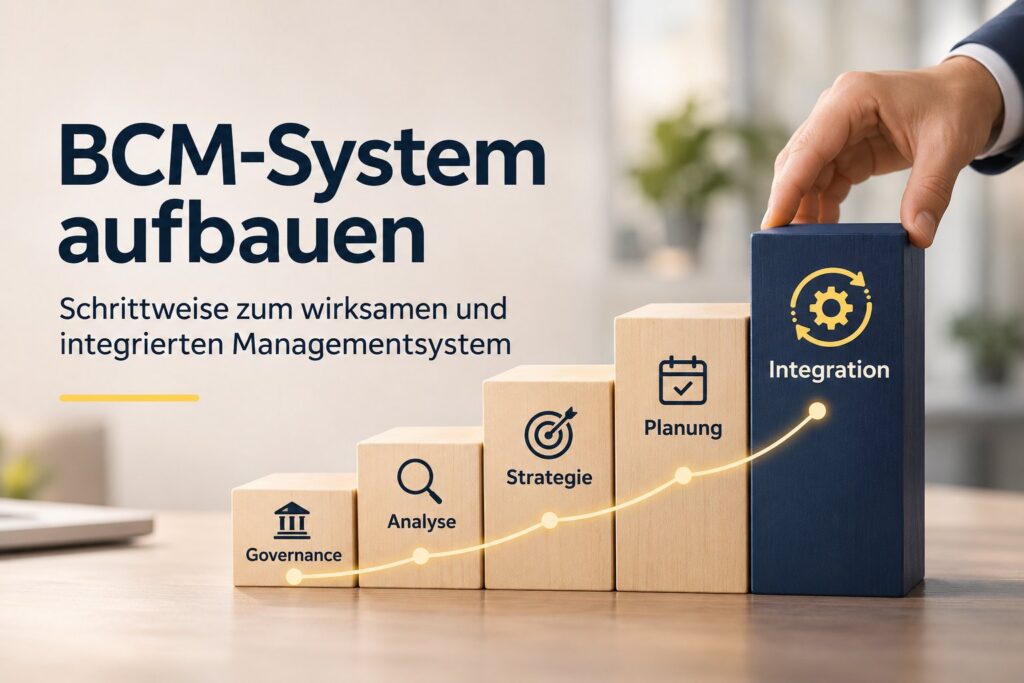
A BCM system does not need to be established all at once. A staged approach has proven effective:
- Obtain the mandate from management and implement the BCM policy.
- Develop the BCM procedure and have the parameters approved.
- Conduct the Business Impact Analysis for the key products and services.
- Decide on strategies and develop plans for time-critical processes and resources.
- Practise, evaluate results and gradually expand the scope.
Conclusion
A framework that supports
A BCM system provides business continuity management with binding authority: clear management decisions, unambiguous roles, streamlined documentation from policy and procedure, and fixed occasions for review. Integrating it with adjacent management systems, rather than duplicating rules, saves effort and lays the foundation for organisation-wide resilience management.
Frequently Asked Questions
Certification, Documents and Approval
Does a BCM system need to be certified according to ISO 22301?
No. ISO 22301 can serve as a guideline without pursuing certification. Whether certification is sensible or required depends on factors such as customers, industry, and regulatory requirements.
What is the difference between policy and procedure?
The policy establishes principles, scope, objectives, and responsibilities and is enacted by management. The procedure describes the specific process – which steps in what order, with what results, and by whom.
Who approves the BCM policy?
Management. ISO 22301 stipulates that top management sets the policy; this underscores that BCM is a management task and not solely a specialist task.
Sources
Standards and Guidelines
The information in this article is based on the following sources. Excerpts from paid standards are not quoted verbatim; their contents are summarised.
- DIN EN ISO 22301:2020-06 – Sicherheit und Resilienz – Business Continuity Management System – Anforderungen (ISO 22301:2019). Deutsche Fassung EN ISO 22301:2019. Herausgeber: DIN Deutsches Institut für Normung e. V., Berlin. Kostenpflichtig über den Normenhandel. ↑
- The Business Continuity Institute: Good Practice Guidelines, Edition 7.0. Herausgeber: The Business Continuity Institute, Caversham. Kostenpflichtig über das BCI. ↑
- Bundesamt für Sicherheit in der Informationstechnik: BSI-Standard 200-4 – Business Continuity Management. Version 1.0, 2023. Frei verfügbar beim BSI. ↑