Table of Contents
Brief Explanation
Exercises and Tests in Five Points
Exercise and Test
People Practice, Technology is Tested
Types of Exercises
From Plan Review to Full Exercise
Exercise Programme
What ISO 22301 Requires
Planning
Objective, Scenario, Roles and Script
Evaluation
From Debriefing to Action Plan
Requirements
ISO 22301, ISO 22361, DORA and NIS2
Conclusion
Practice, Measure, Improve
Frequently Asked Questions
Frequency, Participation and Risks
Sources
Standards, Regulations and Guidelines
Brief Explanation
Exercises and Tests in Five Points
- Exercises and tests demonstrate whether strategies, plans, and the involved people function in an emergency – and whether the target times from the Business Impact Analysis are achievable.
- Exercises involve people with scenarios, while tests assess the functionality of technology and procedures. Both complement each other.
- The types of exercises range from table-top plan reviews to alert and command post exercises, through to functional tests and full-scale exercises; effort and significance increase in this order.
- ISO 22301 requires an exercise programme with objectives and scenarios, conducted at planned intervals and upon significant changes, resulting in reports and improvements.
- The real value lies in the evaluation: Each insight becomes an action with responsibility and deadline, and measured recovery times feed back into BIA, strategy, and plans.
Exercise and Test
People Practice, Technology is Tested
In common usage, both terms are often mixed, but technically, the distinction is worthwhile. A test checks whether a specific procedure or technical measure works – for example, whether a data backup can be restored or whether the emergency generator starts within the intended time. An exercise plays out a scenario with the involved people and checks whether plans, processes, roles, and decisions hold up.[1]
Both are necessary. A test can prove that a system is restored in four hours; whether in a real situation someone decides in time to start the recovery is only shown by the exercise. ISO 22301 combines both in an exercise programme that aims to confirm the strategies and solutions over time.[2]
Types of Exercises and Tests
From Plan Review to Full-Scale Exercise
The BSI Standard 200-4 and German practice distinguish several forms that vary in effort, realism, and significance.[3][1] The following overview is ordered by increasing effort:
| Type | What Happens | What It Shows |
|---|---|---|
| Plan Review (“Desk Test”) | A plan is discussed step by step in a moderated session; nothing is executed in reality. | Whether the plan is complete, coherent, and up-to-date, and if everyone knows their role |
| Alerting Exercise | The alert chain is triggered, and reachability and feedback are measured. | Whether the right people are reached in time – even outside working hours |
| Communication Exercise | Internal and external crisis communication is tested using a scenario. | Whether reporting paths, approvals, and messages work under time pressure |
| Command Post Exercise | The crisis or emergency management team handles a scenario with injected situation reports. | Whether situation assessment, briefings, decision-making, and documentation work within the team |
| Command Post Framework Exercise | Like the Command Post Exercise, but with additional teams involved, such as communication, IT, or locations. | Whether the interaction between the team and operational areas is effective |
| Functional Test | A measure is executed in reality, such as recovery from backup, switching to redundant systems, occupying the emergency workplace, or switching to emergency power after disconnecting from the grid. | Concrete evidence of whether the achievable recovery time (RTA) meets the target time (RTO) |
| Full-Scale Exercise | All levels practice a realistic scenario together, sometimes with actual switchovers. | The effectiveness from end to end – with the highest effort and risk |
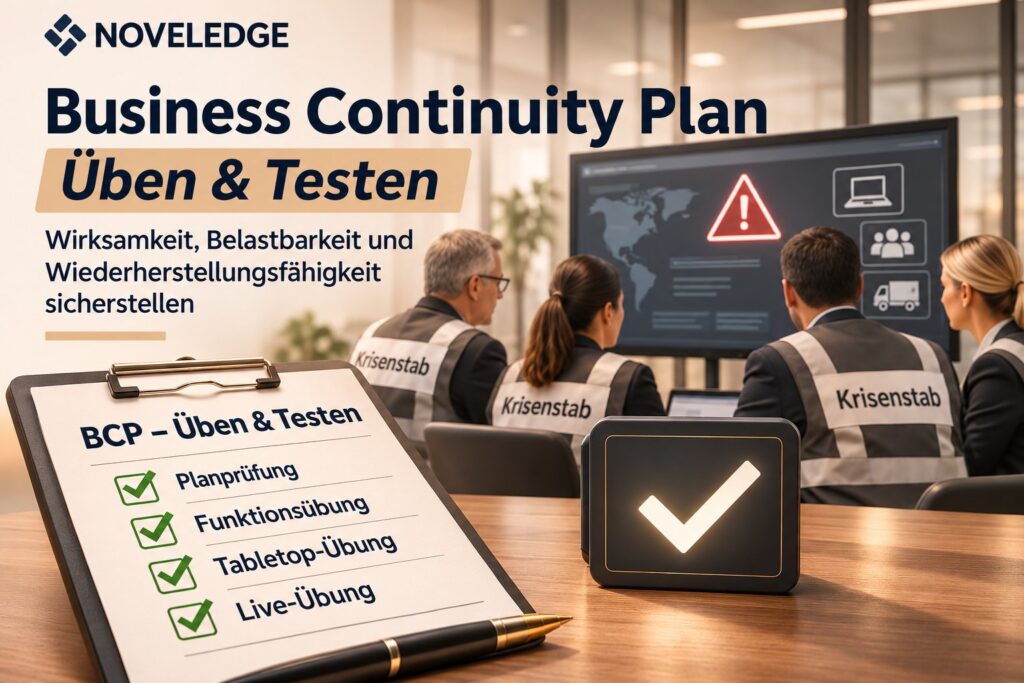
The following presentation summarises the types of tests with their effort and benefits.
International guidelines classify similarly: Tabletop exercises require little preparation and are suitable for thinking through risks, plans, and leadership structures; live play exercises with materials and technology are closest to reality.[4] ISO 22398 provides a general guide for planning, conducting, and improving exercises and exercise programs.[5]
Which type is suitable depends on the objective. New plans start with the plan review; command post exercises become meaningful only when participants know their roles; functional tests are mandatory where the BIA specifies short target times and only the real attempt shows if they are achievable.
The Exercise Program
What ISO 22301 Requires
ISO 22301 does not require a single exercise event, but a program. Exercises and tests should[2]
- align with the objectives of Business Continuity Management,
- be based on suitable scenarios with clearly defined objectives,
- enhance teamwork, competence, safety, and knowledge of those with responsibilities during an event,
- validate the strategies and solutions over time,
- result in a report with outcomes, recommendations, and actions,
- be reviewed for continuous improvement, and
- occur at planned intervals and upon significant changes.
Additionally, the standard requires regular evaluation of the suitability of BCM documentation and capabilities through exercises, tests, and the analysis of actual events, including the continuity capability of key partners and suppliers.[2]
This results in a multi-year exercise plan. It has proven effective to align it with the BIA: the shorter the target time and the greater the impact, the more frequently and realistically exercises are conducted. Over a cycle of several years, all time-critical processes, all plans, and all deputies should have been exercised at least once. The level of difficulty increases gradually, allowing participants to gain confidence rather than becoming overwhelmed.
Planning an Exercise
Objective, Scenario, Roles, and Script
Every exercise begins with an exercise concept. It records:
- Objectives: What is to be demonstrated or learned? Good objectives are verifiable, such as „The team makes the decision to relocate to the alternate site within 60 minutes of the alert.“
- Scope: Which plans, teams, locations, and systems are involved – and which are explicitly not?
- Scenario: A failure that affects the time-critical activities from the BIA and matches the assessed risks. Scenarios are derived from the analysis, not from the most spectacular event.
- Roles: Exercise leadership, control and input of situation reports, observers, participants including deputies.
- Safety rules: Marking of all exercise messages, abort criteria, and precautions to ensure that real operations are not endangered.
- Measurement points: Timestamps for alerting, decisions, and restart, to document the achievable recovery time (RTA).
For command post exercises, a script is added: It specifies which situation reports are to be input when and how the control responds to participants‘ decisions. Only the exercise leadership and control know the script – otherwise, the exercise becomes a demonstration.
In functional tests, the risk to real operations must be carefully weighed. Switchovers are planned during maintenance windows, coordinated with operations, and prepared with a fallback option.
Evaluation and Improvement
From Debriefing to Action Plan
An exercise without evaluation only wastes time. The evaluation follows three stages:
- Immediately afterwards: a brief debriefing with all participants while impressions are fresh, supplemented by a short feedback form.
- Report: Observers and exercise leadership record what worked and what didn’t, compare the measured times with the target times, and derive recommendations. ISO 22301 requires such a report with results, recommendations, and actions.[2]
- Action plan: Each recommendation becomes an action with a responsible person, deadline, and priority. Its effectiveness is shown in the next exercise.[1]
The insights feed back into the entire BCM system. If a functional test shows that the achievable recovery time exceeds the target time, this is a gap to be addressed according to the rules of BC strategies. If it turns out that a target time was set unrealistically, the BIA is reviewed. In the integrated data model, measured recovery times become an ongoing metric. In the BCM system, the results also feed into performance evaluation and management review and trigger corrective actions; ISO 22301 regulates this in sections 9 and 10.
Exercise reports and action plans also serve as evidence to regulators, customers, and auditors that emergency preparedness is not just on paper.[1]
Requirements from Standards and Regulations
ISO 22301, ISO 22361, DORA and NIS2
Most frameworks do not specify in detail how often and how exercises should be conducted. Some requirements are specific:
- ISO 22301 requires exercises and tests at planned intervals and upon significant changes, without specifying a fixed frequency.[2]
- ISO 22361 addresses training, exercises, and learning from crises as integral components of crisis management capability in its crisis management guideline.[6] How it relates to ISO 22320 is explained in the article Crisis Management.
- DORA mandates financial companies to test their ICT business continuity plans as well as ICT response and recovery plans at least annually and after significant changes to ICT systems for critical or important functions; crisis communication plans must be included. Companies that are not micro-enterprises must additionally test cyber-attack scenarios and switch to redundant capacities.[7]
- NIS2 requires measures to maintain operations, such as backup management and disaster recovery, as well as crisis management.[8] What this means for German companies is described in the article NIS2 Implementation in Germany.
Those who already plan, conduct, and evaluate exercises and tests according to ISO 22301 meet the core of these requirements and can substantiate them with the same reports.
Conclusion
Practice, measure, improve
Exercises and tests turn assumptions into evidence. A programme that aligns with the target times of the BIA, starts with simple forms, and gradually increases the level of difficulty reliably shows where plans, strategies, and responsibilities hold and where they do not. The crucial step is the last one: Only when each insight leads to an action that is checked in the next exercise does BCM improve with each exercise.
Frequently Asked Questions
Frequency, participation, and risks
How often should exercises be conducted?
ISO 22301 does not prescribe a fixed frequency but requires exercises at planned intervals and upon significant changes. It has proven effective to conduct exercises with the crisis or emergency management team at least annually and to regularly test time-critical resources with short target times. For financial companies, DORA requires tests at least once a year.
Must the management participate in exercises?
They should participate in team exercises if they make decisions during the event or lead the team. The interaction between management and the team is particularly revealed during the exercise.
Is it allowed to test during ongoing operations?
Yes, if the risk is managed: Switchovers and recoveries are planned, coordinated with operations, conducted in suitable time windows, and secured with a prepared fallback plan.
What is the difference between an exercise plan and an exercise concept?
The exercise plan specifies over one or more years which exercises and tests will take place and when. The exercise concept describes a single exercise with objectives, scenario, roles, safety rules, and measurement points.
Sources
Standards, regulations, and guidelines
The information in this article is based on the following sources. Paid standards are not quoted verbatim; their contents are paraphrased.
- HiSolutions AG: Regulatorik – Üben und Testen. Know-how to go, Berlin, 25.09.2024; and Brochure BCCM – Exercises and Tests. HiSolutions AG, Berlin. ↑
- DIN EN ISO 22301:2020-06 – Security and Resilience – Business Continuity Management System – Requirements (ISO 22301:2019). German version EN ISO 22301:2019, Sections 8.5 and 8.6. Publisher: DIN Deutsches Institut für Normung e. V., Berlin. Available for purchase through standards trade. ↑
- Federal Office for Information Security: BSI Standard 200-4 – Business Continuity Management. Version 1.0, 2023. Freely available from BSI. ↑
- UK Resilience Academy: Exercising Best Practice – Annexes and Resources. Cabinet Office, London, 2024 (updated 2025). Freely available on gov.uk. ↑
- ISO 22398:2013 – Societal security – Guidelines for exercises. International Organization for Standardization, Geneva; last confirmed in 2022. Available for purchase through standards trade. ↑
- DIN EN ISO 22361:2023-02 – Security and Resilience – Crisis Management – Guidelines (ISO 22361:2022). DIN Deutsches Institut für Normung e. V., Berlin. Available for purchase through standards trade. ↑
- Regulation (EU) 2022/2554 on digital operational resilience for the financial sector (DORA), Article 11 Paragraph 6. Official Journal of the EU L 333 of 27.12.2022. ↑
- Directive (EU) 2022/2555 on measures for a high common level of cybersecurity across the Union (NIS-2 Directive), Article 21 Paragraph 2 Letter c. Official Journal of the EU L 333 of 27.12.2022. ↑