
Business Impact Analysis and Related Methods
Distinction, Benefits and Misunderstandings
The Business Impact Analysis (BIA) is a central tool in Business Continuity Management (BCM). Its focus is on determining the criticality of processes and their time-dependent impacts on the organisation. It follows the All-Hazards approach, considering the consequences of a process failure and the resources needed for recovery, regardless of the cause.

Table of Contents
What is the BIA
BCM Lifecycle
Where to Start
What is actually decisive for my criticalities
BIA and Protection Needs Analysis
Two Analyses, One Common Goal
BIA and its All-Hazards Approach
A Comparison to Other Analyses
BIA in Comparison
Distinction from Other Analytical Tools
Limits of the BIA
BIA, RIA, DORA[1], Obligations Analysis and Protection Needs Analysis
Sources
References and Further Sources
What is a Business Impact Analysis (BIA)?
The Business Impact Analysis (BIA) is a central analytical tool in Business Continuity Management (BCM). It is used to systematically assess the impacts of disruptions on business processes and to determine from which point a failure is no longer acceptable for the organisation. The aim of the BIA is not to analyse causes or specific scenarios, but to make the temporal vulnerability of the organisation transparent.
In the BCM Lifecycle, the BIA forms the technical basis for all further measures. It stands at the transition between the strategic goal definition of BCM and the operational design of recovery, emergency, and resilience concepts. Without a reliable BIA, priorities, timeframes, and a comprehensible decision-making basis are lacking.
The BCM lifecycle follows a structured approach: define objectives, analyse risks and impacts, derive measures, test and continuously improve. Within this cycle, the BIA plays a key role as it addresses the impact dimension.
While risk analyses answer what could happen, the BIA answers the question of what happens if something fails, regardless of the cause. It thus provides a scenario-independent view of the organisation and follows the all-hazards approach of BCM.
- The results of the BIA directly influence:
- as well as subsequent analyses, such as risk or protection needs analyses.
- the definition of recovery strategies,
- the prioritisation of resources,
- the development of emergency and recovery plans,
Objective and Basic Logic of Business Impact Analysis
Central metrics of the BIA are the Maximum Tolerable Period of Disruption (MTPD) and the Recovery Time Objective (RTO). The MTPD describes the maximum allowable downtime of a process, while the RTO defines a specific recovery target that must be met within this limit. The resulting timeframes directly affect the identified resources and determine within what timeframe these must be available or restored to continue the process.
At its core, the Business Impact Analysis (BIA) pursues two main objectives:
- Identification of time-critical business processes
- Identification of time-critical resources
All further considerations serve solely to achieve these two objectives in a comprehensible and reliable manner.
The central aim of the BIA is to identify those business processes whose interruption within a certain period leads to unacceptable damage. The time-criticality of a process is determined by the assessment of the impact of a failure and the evaluation of the maximum tolerable downtime. How financial damage develops over time and how financial impact thresholds can be aligned is shown in the article on financial resilience.
Building on the identified time-critical business processes, the BIA’s second objective is the identification of the necessary time-critical resources. This involves determining the resources needed to maintain a time-critical process or restore it within the defined timeframes.
Resources that are essential for carrying out a time-critical process are considered time-critical resources within the context of the BIA. The timeframes defined in the BIA directly affect these resources and determine within what timeframe their availability or restoration must be ensured.
An additional, often optionally treated but practically essential aspect of the Business Impact Analysis is the identification of process interfaces and dependencies. Time-critical business processes rarely stand alone but are usually closely linked with preceding, succeeding, and parallel processes. The BIA also serves to make these process dependencies transparent and to show which interfaces are essential for the continuation of a time-critical process.
By systematically examining interfaces and dependencies, it becomes clear which processes are interlinked in terms of time, organisation, or resources. This integration prevents isolated individual assessments and enables a consistent understanding and communication of time-critical requirements across the entire process landscape. Interfaces often reveal the true vulnerabilities of an organisation, providing a key focal point for effective business continuity measures.
NOVELEDGE BCM Steps by NOVELEDGEWhere is it sensible to start with the Business Impact Analysis?
One of the first and most crucial practical questions in the context of a Business Impact Analysis is the definition of the scope, i.e., the extent of the processes to be considered within an organisation. This question is not only methodologically relevant but also decisive for whether the analysis remains manageable, effective, and applicable.
From practice, a clear recommendation can be derived:
The process review should start with the business processes, i.e., where value creation and revenue are directly generated. In manufacturing companies, this is typically the sales department. Sales processes have the most direct impact on revenue, customer relationships, and market position. They define what, when, and to what extent services should be delivered.
Upstream processes – such as production, logistics, or procurement – are generally aligned with these requirements. If the BIA starts with the sales processes, their criticality can be systematically transferred to upstream business processes. This approach makes dependencies, interactions, and impacts visible early on without artificially expanding the scope. At the same time, it enables an end-to-end view of the central value chain.
This explicitly does not mean that other essential processes are disregarded. Nor does it exclude the existence of other time-critical processes that have a direct impact on revenue or play a central role for the organisation. The recommendation refers more to the starting point of the analysis – not its complete scope.
Especially in the context of limited resources, it holds true: Those who try to consider everything at once often end up with no reliable results. A clearly defined initial review is therefore not a methodological deficiency but a conscious decision. The scope of a BIA is not static but is iteratively expanded, adjusted, and deepened throughout the BCM lifecycle – in line with growing maturity, increasing resilience, and the available organisational resources.
BCM, BIA and Protection Needs Analysis
Two analyses, one common goal
In many organisations, the Business Impact Analysis (BIA) and the Protection Needs Analysis are conducted separately. The BIA is associated with Business Continuity Management (BCM) or IT Service Continuity Management (ITSCM), while the Protection Needs Analysis regularly originates from the context of information security.
This separation is historically understandable but only partially sensible from a professional standpoint. Both analytical approaches ultimately pursue the same overarching goal of protecting the organisation from existential threats.
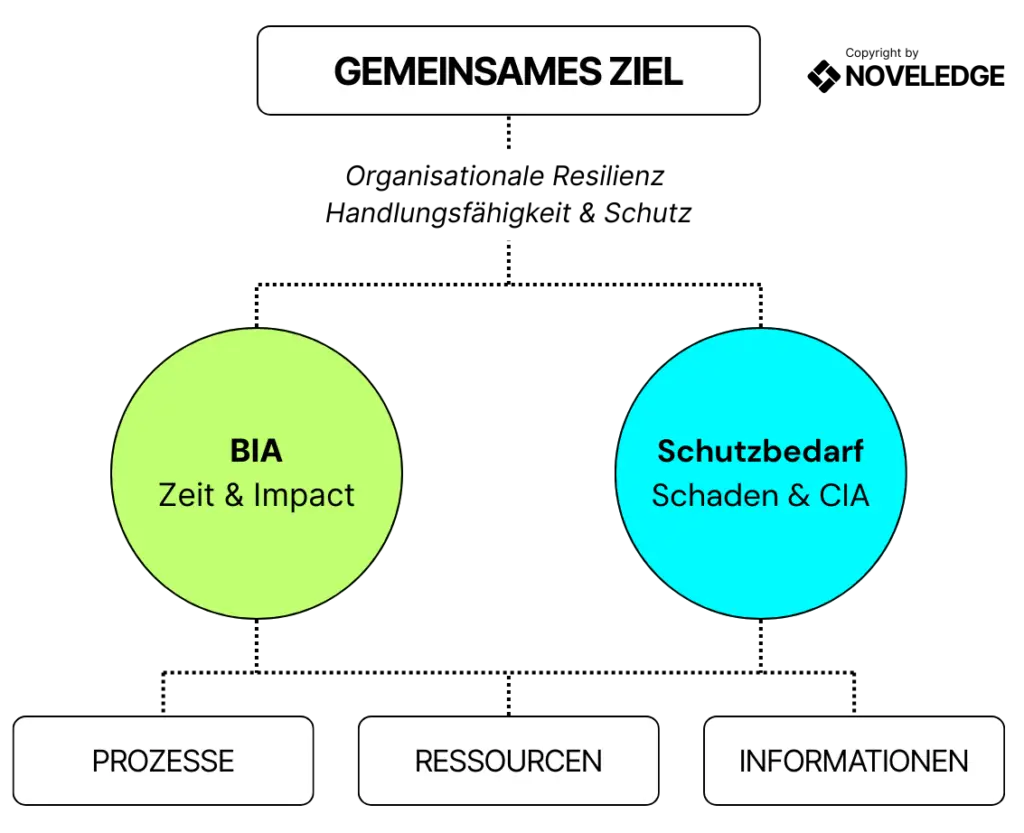
Common Goal
Resilience instead of silo thinking
Both the BIA and the protection needs analysis aim to make critical values, dependencies, and damage potentials transparent. The difference lies less in the goal and more in the perspective. While the BIA primarily considers the time-criticality of processes and the impacts of disruptions, the protection needs analysis focuses on the extent of damage when its protection objectives, particularly confidentiality, integrity, and availability, are violated.
In an integrated view, these perspectives complement each other – they do not contradict but describe different dimensions of the same reality. The resources form the central intersection through which processes must be continued and information protected.
The BIA is the central analysis tool within BCM and thus an essential component of an effective Business Continuity Management System. It serves to systematically identify time-critical business processes by structurally assessing the impacts of a failure. The focus is not on the cause of a disruption but on its time-dependent consequences for the organisation.
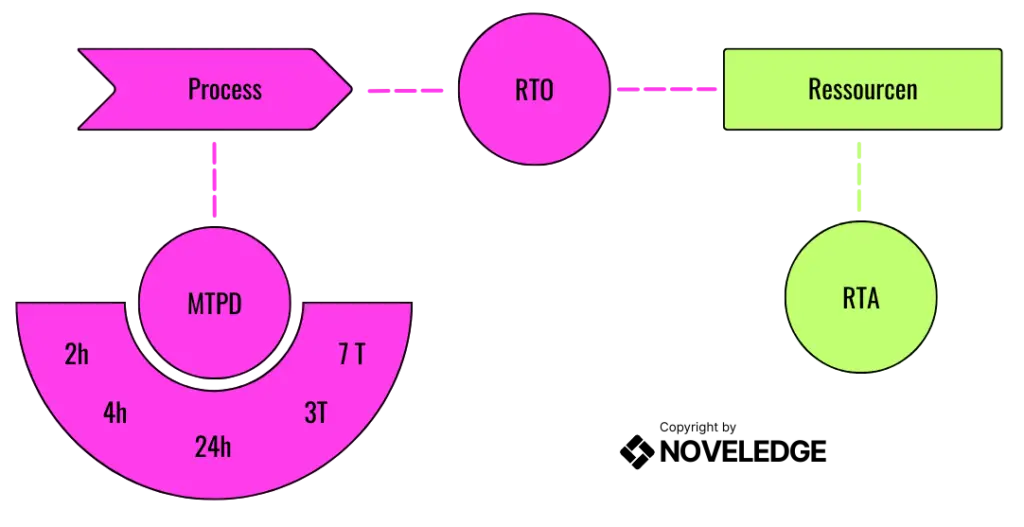
Within the framework of the BIA, it is analysed from which point a failure is no longer bearable for the organisation or even has existentially threatening effects. This point is defined as the Maximum Tolerable Period of Disruption (MTPD), or the maximum tolerable downtime (MTA). The MTPD thus describes the absolute time limit within which a process must be restored or replaced to avoid irreversible damage.
Based on this assessment, a Recovery Time Objective (RTO) is set for each critical process. The RTO defines the target for restoring process capability, i.e., the point in time by which a process must be available again to remain within the limit set by the MTPD. While the MTPD describes the extreme limit of endurance, the RTO represents a concrete, manageable recovery target.
The time-criticality of a business process thus results from the interplay of impact assessment, MTPD, and RTO. A process can generally be replaceable or compensable, but if it is interrupted for too long, irreversible damages occur, such as legal, economic, or reputational. This is precisely where the BIA creates transparency and forms the basis for prioritisation, restart strategies, and further measures in the BCM lifecycle.
Not every risk is critical, but every critical time overrun is a risk.
The Protection Needs Analysis
Understanding damage dimensions
The protection needs analysis traditionally originates from information security and serves to systematically determine the protection needs of information, information objects, and the resources supporting them. What is crucial is not only the information itself but also the resource on which the information is processed, stored, or provided. A defined protection need thus always acts across objects and resources and forms the basis for appropriate technical and organisational protective measures.
Confidentiality describes the potential damage that occurs when information is disclosed or accessed without authorization. Integrity assesses the impact of manipulation, loss of accuracy, or incomplete information. Availability considers the damage that arises when information or information processing systems are not available or not available in a timely manner. At the heart of the protection needs analysis is the qualitative and quantitative extent of damage, not primarily the duration of a disruption.
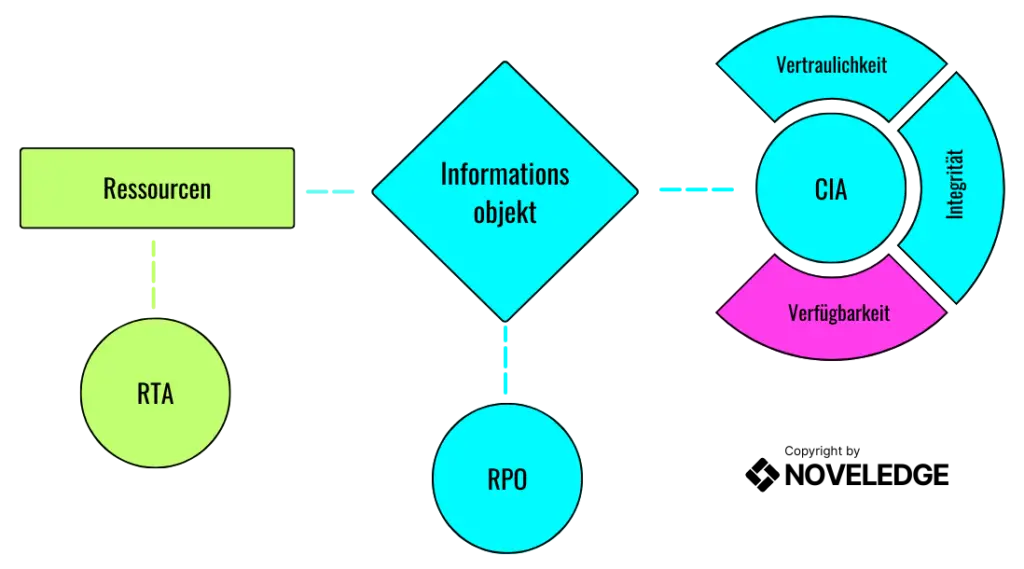
Particularly with regard to availability, a distinct demarcation and at the same time interface problem becomes apparent. In the protection needs analysis, the focus is initially on assessing the damage that occurs when information is not available. This assessment describes the What and How severe, but not automatically the How long. As soon as it comes to defining specific requirements for re-availability, the maximum tolerable period of disruption becomes relevant. This time limit is crucial for defining recovery objectives and cannot be considered in isolation from the protection needs analysis.
At this point, it becomes clear that protection needs analysis and BIA are closely intertwined. While the protection needs analysis describes the damage potential in case of non-availability, the BIA provides the temporal classification from when this damage is no longer acceptable for the business. Information security and business continuity meet directly here and require a joint, integrated consideration.
Another central aspect in this context is the Recovery Point Objective (RPO). The RPO describes the maximum tolerable data loss in time, i.e., the point in time by which information must at least be restored during recovery. Unlike technical backup intervals, the RPO is not purely a technical derivation but a clear business requirement. It answers the question of which information and to what extent can be dispensed with in the event of a loss without causing unacceptable damage.
The determination of the RPO results from the assessment of availability, the RTO, and the practical question of whether and how information can be manually or organizationally reconstructed within a certain period. Real factors also play a role: Are sufficient personnel and organizational resources available? Is it practically possible to re-collect or reprocess the information? This consideration focuses on feasibility, not just theoretical possibility.
Overall, it becomes apparent that protection needs analysis, BIA, as well as RTO and RPO, are not isolated metrics but closely linked decision variables. They connect the digital world of information security directly with the operational requirements of the business and make it clear that resilience can only be achieved through a joint, consistent consideration of these analytical perspectives.
Not every failure is critical, but every high damage is relevant, regardless of the cause.
Risk Assessment
Purpose of a Risk Assessment in BCM
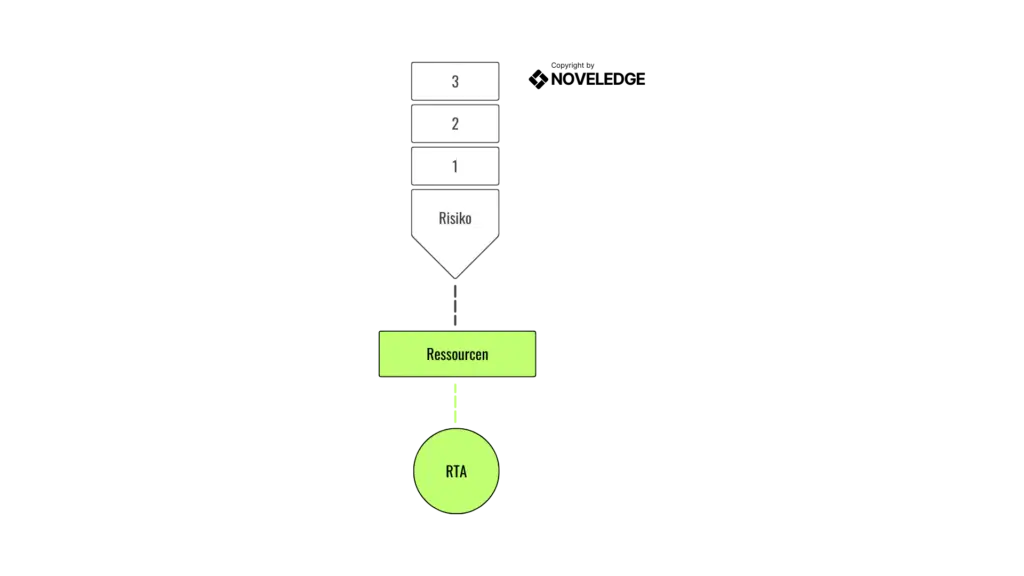
The Risk Assessment in Business Continuity Management is used to specifically evaluate the critical resources identified in the BIA in light of specific risks and to practically secure the previously determined protection and time requirements. While the BIA determines what is critical and how quickly a response is needed, the Risk Assessment answers the question of which real threats these resources are actually exposed to and to what extent protective measures are necessary. This allows protective measures to be designed in a targeted, risk-oriented, and economically sensible manner, rather than being oversized in a blanket or purely theoretical way. Without this risk-based evaluation, there would be a danger of either insufficiently securing resources or making unnecessarily high investments in measures that do not address the actual threat situation. Thus, the Risk Assessment forms the crucial bridge between analysis, protection needs, and an implementable business continuity strategy.
NOVELEDGE BIA RIA Protection Needs by NOVELEDGE
The Meaningful Connection
Two Perspectives, One Analysis Architecture
The real strength unfolds where BIA and protection needs analysis are not conducted in isolation or sequentially, but are coordinated in content. Instead of building two separate analysis worlds, an integrated approach is recommended, where the BIA serves as a structural framework and the protection needs analysis deepens this structure technically.
The starting point is the BIA, which identifies critical business and tactical processes and assesses their time criticality. By defining MTPD/MTA and RTO, it is determined from which point a failure is no longer acceptable and when a process must be available again at the latest. Based on this, the necessary resources are derived, including IT and OT systems, information, personnel, and external dependencies. This means that the resources required to maintain the process must be determined here, in order to define a so-called emergency operation needed to control failures. The BIA thus creates a clear prioritisation and determines where action is needed.
Building on this, the protection needs analysis is conducted at the resource and information object level. Here, the damage potential of the identified resources and information is assessed and differentiated along the CIA criteria. The key is the alignment with the time criticality from the BIA. Information with high protection needs that also supports time-critical processes requires different protection and recovery measures than less critical objects. The resource here forms the central interface between process view and information security.
This coordinated approach creates a consistent overall picture that brings together different analysis perspectives. The BIA answers the question of which processes and resources are time-critical and how quickly a response is needed, while the protection needs analysis explains which information and resources are critical and how strongly they need to be protected. Time dimension and damage dimension are not considered separately, but are deliberately linked.
Such an integrated analysis is not only technically sensible but also practically efficient. It avoids duplication of work, reduces coordination efforts, and creates a unified data and decision-making basis for BCM, information security, and risk management. Especially in the recording of resources, dependencies, and priorities, it becomes evident that a joint consideration can significantly contribute to saving resources and improving the quality of results.
For practical implementation, it is advisable to conduct a uniform analysis and develop a common documentation approach that structurally combines both perspectives. Relevant templates can support the consistent recording of BIA and protection requirements aspects, making the results directly usable for further BCM and security measures without establishing additional parallel structures.
Normative Classification
Which requirements are met?
An integrated approach allows multiple standards to be addressed coherently and without duplication of effort:
- ISO 22301[2] (BCM)– Requirements for BIA, critical processes, recovery objectives, and exercise concepts
- ISO/IEC 27001[3] (ISMS)– Determination of protection needs, risk analysis, derivation of appropriate protective measures
- BSI Standards (e.g., 200-2, 200-4)– Methodological integration of BIA, protection needs analysis, and emergency management
- ISO 22316[4] (Organisational Resilience)– Holistic view of resilience across silos
The key is not the formal fulfilment of individual chapters, but the logical connectivity of the results.
A Common Vision Instead of Parallel Documents
When BIA and protection needs analysis are considered separately, contradictory results often arise:
- Processes with high time criticality but low protection needs
- Systems with high protection needs but without clear recovery objectives
An integrated analysis prevents exactly these discrepancies or at least makes the need for action clear. It creates:
- Clarity in prioritisation
- Consistency between BCM, ISMS, and crisis management
- A reliable basis for decision-making regarding investments and measures
The Subtle Difference to the All-Hazards Approach
The essential difference between traditional analysis methods and the Business Impact Analysis (BIA) lies not in the depth of individual methods, but in the fundamental approach. Traditional analyses such as Fault Tree, Root Cause, Scenario, Bow-Tie, or SWOT analyses are generally cause-, scenario-, or event-oriented. They assume known or at least conceivable threats and analyse their occurrence, causes, or interdependencies. The BIA, on the other hand, follows an all-hazards approach: It deliberately abstracts from specific scenarios and instead asks, what impact a failure would have regardless of its cause.
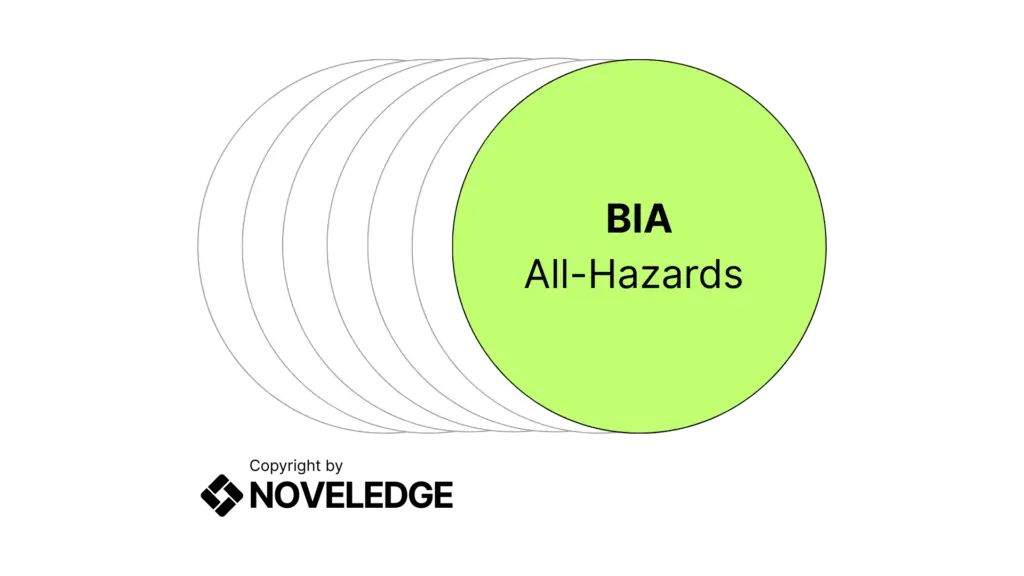
This scenario-independent impact assessment is essential, particularly against the backdrop of a highly dynamic, unpredictable environment. Traditional risk and scenario analyses reach their limits where threats change rapidly, overlap, or emerge in new forms. In addition to the well-known VUCA environment (Volatility, Uncertainty, Complexity, Ambiguity), the BANI model is increasingly being used, describing a brittle, anxious, non-linear, and incomprehensible reality. In such environments, it is hardly possible to validly define all relevant scenarios in advance.
The all-hazards approach of the BIA takes this development into account. It does not ask “What could happen?” but rather “What would happen if it fails – regardless of the reason?”. This shifts the focus from predicting individual risks to the systematic assessment of organisational resilience. This change in perspective makes the BIA a central element of Business Continuity Management and an indispensable complement – not a replacement – to traditional analysis approaches.
BIA in Comparison
Organisations use a variety of different analytical tools to identify risks, vulnerabilities, and areas for action – including methods such as Fault Tree Analysis, Root Cause Analysis, Scenario Analysis, Risk Matrix, Bow-Tie Analysis, or SWOT Analysis. These approaches differ significantly in their objectives, levels of consideration, and significance. The following comparison categorises these methods and highlights how the Business Impact Analysis (BIA) differentiates and complements itself within the context of Business Continuity Management (BCM).
However, there is often confusion with other analytical procedures that appear similar at first glance. These methods have valuable applications but are not suitable as a replacement for the BIA in the BCM context, to secure the crucial business processes independently of scenarios and ultimately ensure the core business.
The following presents some typical and widespread analyses that, while important components for organisations, have clearly defined application areas that often have limitations arising from their history.
Fault Tree Analysis (FTA)
The Fault Tree Analysis (FTA) is a classic tool for cause and fault chain analysis. It follows a deductive approach, analysing backwards from a defined undesirable event – such as the failure of a system or process – to determine which combinations of technical, organisational, or human errors could lead to this event. The aim of the FTA is to transparently display dependencies, vulnerabilities, and critical combinations of individual events.
In the context of Business Continuity Management, the Fault Tree Analysis can particularly help to make vulnerabilities in critical processes and resources visible. It is well-suited to identifying weaknesses within existing structures and deriving targeted preventive measures, such as through redundancies, technical safeguards, or organisational controls.
Compared to the Business Impact Analysis (BIA), the focus of the FTA is fundamentally different. While the BIA examines what business impacts a process failure would have and from what point this is no longer tolerable, the FTA exclusively analyses the causes and fault chains that could lead to such a failure. Thus, the FTA answers the “How does it happen?”, but not the “How critical is it for the business?”.
Therefore, the Fault Tree Analysis complements the BIA but does not replace it. The BIA deliberately starts scenario-independently and assesses the impact of a failure regardless of its cause. Only in the combination of both approaches – BIA for prioritising critical processes and FTA for analysing their vulnerabilities – does a robust foundation for effective and economically sensible business continuity measures emerge.
Failure Mode and Effects Analysis (FMEA)
The Failure Mode and Effects Analysis (FMEA) is a systematic method for the identification and assessment of potential failure modes and their effects on components, products, or technical systems. It is particularly used in technical and production-related areas to identify potential sources of error at an early stage, evaluate their likelihood of occurrence, and derive appropriate preventive measures.
Within the framework of Business Continuity Management, FMEA is particularly beneficial where technical dependencies play a central role, such as in IT systems, production facilities, or critical infrastructure. It enables a detailed analysis of technical risks and assists in specifically addressing vulnerabilities before they lead to disruptions or failures.
In comparison to the Business Impact Analysis (BIA), the FMEA has a significantly narrower focus. While the BIA evaluates from an organisational perspective which processes are critical to business operations and at what point a disruption becomes unacceptable, the FMEA concentrates on technical detail risks of individual components or systems. It therefore does not consider the overall process criticality and the business impacts of a failure, but primarily the technical susceptibility to errors. und die geschäftlichen Auswirkungen eines Ausfalls, sondern primär die technische Fehleranfälligkeit.
The FMEA therefore complements the BIA effectively on the technical level, but does not replace it. Only through the combination of a BIA for prioritising critical processes and an FMEA for detailed analysis of technical vulnerabilities can business continuity measures be implemented in a targeted, effective, and economical manner.
Root Cause Analysis (RCA)
The Root Cause Analysis (RCA) is a method for the systematic investigation of the underlying causes of disruptions or incidents that have already occurred. The aim of RCA is not only to identify the immediate symptoms of an event but to uncover the fundamental organisational, technical or human causes in order to prevent similar events in the future.
In the context of Business Continuity Management, RCA is particularly important in the framework of Lessons Learned following crises, emergencies, or significant disruptions. It helps organisations to sustainably address vulnerabilities, improve processes, and specifically develop preventive measures further.
In contrast to the Business Impact Analysis (BIA), the RCA is reactive. While the BIA proactively assesses which processes are critical and what recovery times are necessary, the RCA analyses events only after they have occurred. Therefore, it does not provide a basis for the preventive determination of recovery objectives or priorities, but rather complements the BIA retrospectively as a learning and improvement-oriented tool.
Scenario Analysis
The scenario analysis examines possible future scenarios and their potential impacts on organisations, processes or systems. It operates with plausible assumptions about external and internal influencing factors and serves to prepare courses of action for different developments.
In Business Continuity Management, scenario analysis can help to realistically consider crisis situations and train decision-making ability under uncertainty. It particularly supports the sensitisation of executives and preparation for exceptional situations.
In contrast to the Business Impact Analysis (BIA), scenario analysis is scenario-dependent and thus limited to assumed events. The BIA deliberately avoids specific scenarios and assesses the impact of a disruption regardless of its cause, thereby providing a more stable basis for prioritisation and recovery objectives.
Bowtie Analysis
The Bow-Tie Analysis combines elements of cause analysis and impact analysis by representing a risk event in the centre, with its causes on the left side and impacts on the right side. Additionally, preventive and reactive barriers are visualised.
In the BCM context, the Bow-Tie Analysis is suitable for clearly illustrating risk relationships and structuring protective and emergency measures in an organised manner. It is particularly helpful in communication and risk dialogue.
In comparison to the BIA, the Bow-Tie Analysis remains event-focused. It examines risks along defined scenarios, while the BIA focuses on the business impacts of process disruptions and assesses the temporal dimension independently of specific causes.
Monte Carlo Analysis
The Monte Carlo Simulation is a quantitative analysis method based on the simulation of probabilities and impact ranges. By repeatedly calculating random-based scenarios, possible outcome spaces, probability distributions, and uncertainties can be modelled.
In the context of Business Continuity Management, the Monte Carlo Simulation can particularly contribute to quantitative risk assessment and resource and capacity planning. It supports informed decisions where sufficiently reliable data on probabilities, damage levels, or recovery times are available.
Compared to the Business Impact Analysis (BIA), the Monte Carlo Simulation is significantly more data-, scenario-, and probability-dependent. It requires a detailed and valid data basis and is especially suitable for modelling known risks. The BIA, on the other hand, follows a scenario-independent all-hazards approach and evaluates the impact of a disruption regardless of its probability. Thus, the Monte Carlo Simulation complements the BIA in in-depth quantitative questions but does not replace its role as a fundamental prioritisation tool in BCM.
SWOT Analysis
The SWOT Analysis is a strategic tool for the structured examination of an organisation’s strengths, weaknesses, opportunities, and threats. It primarily serves to reflect on one’s positioning and derive strategic action fields.
In the context of Business Continuity Management, the SWOT Analysis can help anchor BCM as a strategic success factor, for instance, by understanding resilience, reliability, or regulatory compliance as competitive advantages. It is particularly suitable for integrating BCM into overarching corporate or risk strategies.
Compared to the Business Impact Analysis (BIA), the SWOT Analysis remains on a purely strategic level. It does not provide insights into the time-criticality of processes, recovery objectives, or operational priorities in the event of a disruption. Thus, it can usefully complement the BIA but is not suitable to replace its role as a central analysis tool in BCM.
Comparison Overview
Business Impact Analysis and Related Methods
Method Focus / Objective Benefit in BCM Disadvantage Compared to BIA Suitable When …
Business Impact Analysis (BIA) Assessment of process criticality, impact of disruptions, derivation of RTO/MTPD Central foundation for BCM, defines priorities and resources – Always necessary when processes need to be prioritised by criticality
Fault Tree Analysis (FTA) Analysis of fault chains and causes of disruptions Identification of weaknesses in critical processes Focuses on causes, not impacts When cause chains of process disruptions need to be understood
Failure Mode and Effects Analysis (FMEA) Examination of possible failure modes and consequences for systems/products Detailed technical risk analysis Focuses on technology, not business processes When technical components or IT systems are considered
Root Cause Analysis (RCA) Identification of the root causes of occurred disruptions Valuable for lessons learned and improvements Only effective after a disruption When past disruptions need to be analysed and avoided
Scenario Analysis „What-if“ consideration of different future scenarios Strategic stress testing of BCM plans Scenarios are selective, not all-hazards When individual scenarios are played out or trends are evaluated
Risk Matrix / Bowtie Visualisation of risks, probabilities, measures Overview of controls and prevention Focus on probability of occurrence rather than process criticality When risks need to be qualitatively assessed and measures highlighted
Monte Carlo Analysis Simulation of probabilities and impact ranges Quantitative substantiation of risks Complex, data-intensive, scenario-based Numerical risk assessments required
SWOT Analysis Strategic assessment of strengths, weaknesses, opportunities, risks Integration of BCM into overall strategy Purely strategic, no process details BCM should be made visible in the corporate strategy
Conclusion
While methods like FTA, FMEA or scenario analyses can be useful additions, their strength lies in the detailed analysis of specific risks or scenarios. The BIA, on the other hand, is indispensable for effective BCM because it follows the all-hazards approach and focuses holistically on the impacts of process disruptions.
Precisely the clear delineation prevents misunderstandings and shows that the mentioned methods in conjunction with the BIA create added value – but can never replace its role in BCM.
Business Impact Analysis and DORA
Compatible, but not sufficient
With Regulation (EU) 2022/2554 on digital operational resilience (Digital Operational Resilience Act, DORA), the European legislator aims to systematically strengthen the digital operational resilience of financial companies (European Union, 2022, Recitals 1–3, pp. 1–2). A central element of the regulation is the identification and safeguarding of critical or important functions (“critical or important functions”, CIFs), whose failure can have significant impacts on the financial system, market participants or supervisory requirements (European Union, 2022, Art. 3 No. 22, p. 14).
Against this backdrop, the question arises as to the extent to which the Business Impact Analysis (BIA) as a classic tool of Business Continuity Management contributes to meeting these requirements – and where its conceptual limits lie.
Contribution of the Business Impact Analysis to Meeting DORA Requirements
The DORA regulation explicitly obliges financial companies to conduct a Business Impact Analysis as part of their ICT risk management and business continuity arrangements (European Union, 2022, Art. 11 Para. 5, pp. 32–33). The aim is to systematically assess the potential impacts of severe operational disruptions on company functions, processes, information resources and dependencies.
The classic BIA makes a significant contribution to this by:
- identifying time-critical business processes,
- assessing the impacts of disruptions and
- making transparent through metrics such as MTPD and RTO the point at which a failure becomes untenable for the organisation.
Thus, the BIA directly supports the DORA requirement to establish recovery objectives for critical or important functions and to incorporate these into business continuity and recovery plans (European Union, 2022, Art. 11 Paras. 6–7, pp. 33–34).
Limits of the Classic BIA in the DORA Context
At the same time, DORA shows that time criticality alone is not a sufficient criterion for classifying critical or important functions. The regulation explicitly clarifies that supervisory, market and regulatory impacts must also be considered in the assessment (European Union, 2022, Recital 24, p. 6).
Functions can therefore be regulatory essential, even if their short-term failure appears tolerable from a purely business perspective. However, traditional BIA approaches often focus on financial, operational, or reputational damage and do not always capture regulatory consequences as a separate impact dimension. This poses the risk that functions essential for compliance with regulatory obligations are not recognised as critical or are under-prioritised (cf. European Union, 2022, Art. 11 in conjunction with Art. 6, pp. 25–34).
Extension of the BIA
Integrating Regulatory Impacts
DORA explicitly opens the space for an extended impact assessment. The recitals emphasise that recovery objectives should be set not only based on internal economic criteria but also considering external impacts on financial markets, customers, and regulatory structures (European Union, 2022, Recitals 9 and 35, pp. 3 and 8).
Therefore, a further development of the BIA in the sense of DORA means supplementing the impact analysis with a regulatory dimension. In addition to examining what internal damage occurs, it is systematically necessary to assess which regulatory obligations can no longer be fulfilled in the event of a failure and what regulatory consequences would result from this.
On this basis, maximum tolerable downtimes can be justified not only economically but also regulatorily, as DORA requires for critical or important functions (European Union, 2022, Art. 11 Para. 8, p. 34).
The Triangular Approach
BIA, Protection Needs Analysis and DORA Requirements
The DORA regulation makes it clear that an isolated consideration of individual analysis tools is not sufficient. A integrated approach that combines three perspectives is effective:
- the Business Impact Analysis for assessing time criticality and impacts,
- the Protection Needs Analysis for assessing the damage potential of information and resources,
- and the regulatory requirements according to DORA for identifying critical or important functions independent of purely operational criteria.
Only through the interplay of these perspectives does it become transparent which functions are indispensable from a business, security, and regulatory perspective. At the same time, this approach supports the principle of proportionality anchored in DORA, by designing measures in a targeted and risk-oriented manner (European Union, 2022, Art. 4 Para. 2, p. 21).
Conclusion
The Business Impact Analysis is a central and explicitly required tool by DORA, but not a sufficient means alone for identifying critical or important functions. Its strength lies in the temporal and impact-related analysis, its limitation in the lack of systematic consideration of regulatory impacts. However, through an extended impact assessment and the linkage with protection needs analysis and regulatory context, the BIA can be specifically developed further and expanded into a viable component of a DORA-compliant resilience architecture.
Sources
The information in this article is based on the following sources. No direct quotations are taken from paid standards; their contents are reproduced in essence.
- Regulation (EU) 2022/2554 on digital operational resilience for the financial sector (DORA). Freely available at EUR-Lex. ↑
- DIN EN ISO 22301:2020-06 – Security and resilience – Business Continuity Management Systems – Requirements (ISO 22301:2019). German version EN ISO 22301:2019. Publisher: DIN Deutsches Institut für Normung e. V., Berlin. Available for purchase through standards trade. ↑
- ISO/IEC 27001:2022 – Information security, cybersecurity and privacy protection – Information security management systems – Requirements. Publisher: International Organization for Standardization and International Electrotechnical Commission, Geneva. Available for purchase through standards trade. ↑
- ISO 22316:2017 – Security and resilience – Organizational resilience – Principles and attributes. Publisher: International Organization for Standardization, Geneva. Available for purchase through standards trade. ↑